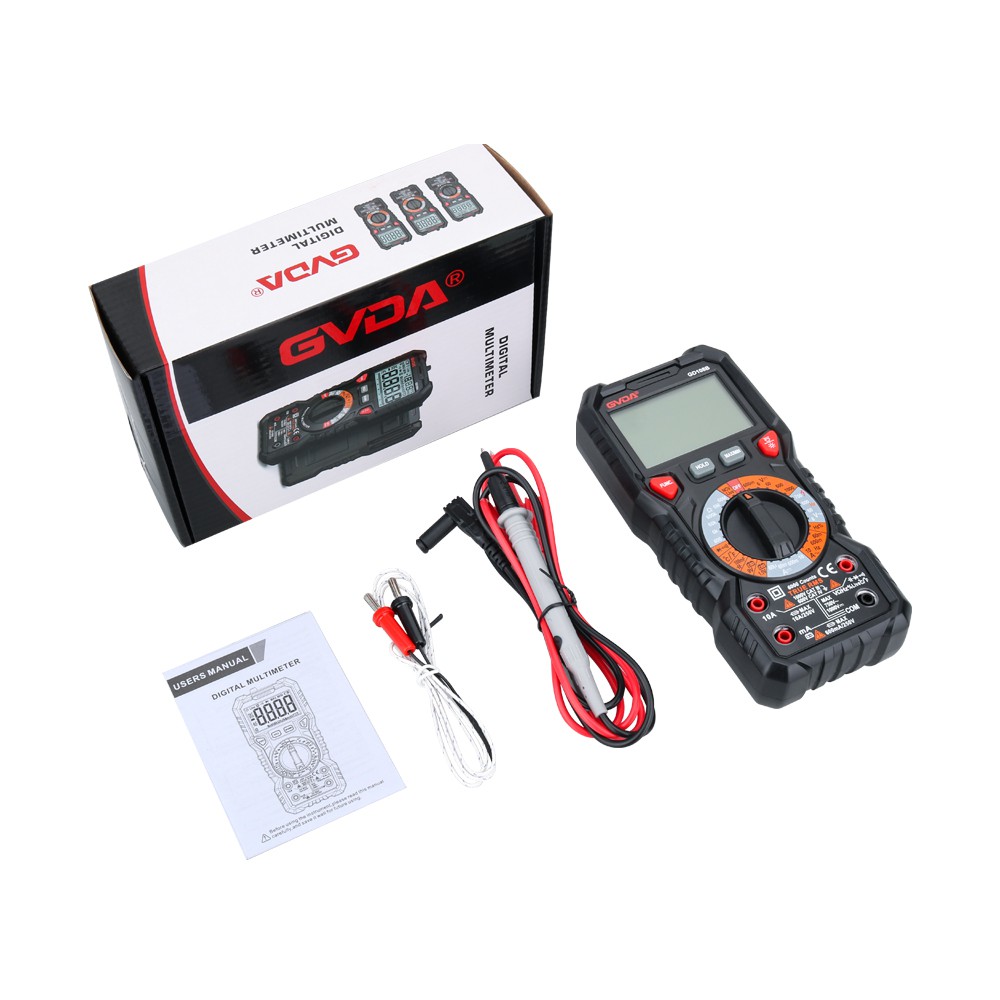
Maintenance and upkeep of digital multimeters
1. Maintenance
A digital multimeter is a precision electronic instrument. Do not change the circuit randomly, and pay attention to the following points:
1. Do not connect to voltages higher than 1000V DC or 700V AC RMS
2. Do not connect the voltage source when the function switch is in Ω and position
3. Do not use this meter when the battery is not properly installed or the back cover is not tightened
2. Repair methods
Digital multimeters have high sensitivity and accuracy, and their applications are almost ubiquitous in all enterprises. However, due to the multifactorial nature of its failures and the high randomness of encountered problems, there are not many rules to follow. Therefore, some repair experience accumulated in practical work will be compiled for reference by colleagues in this field.
Finding faults should start from the outside and then from the inside, from easy to difficult, break them down into smaller parts, and focus on breakthroughs. The methods can be roughly divided into the following:
1. Sensory method
By relying on sensory perception, the cause of the malfunction can be directly judged. Through visual inspection, it can be found that faults such as broken wires, desoldering, short circuits, broken fuse tubes, burnt components, mechanical damage, copper foil lifting and breaking on printed circuits, etc; You can touch the temperature rise of the battery, resistor, transistor, and integrated block, and refer to the circuit diagram to identify the cause of abnormal temperature rise. In addition, you can also check by hand whether the components are loose, whether the integrated circuit pins are securely inserted, and whether the conversion switch is stuck; You can hear and smell any unusual sounds or odors.
2. Voltage measurement method
Measuring the working voltage of each key point can quickly identify the fault point. Measure the working voltage and reference voltage of the A/D converter.
3. Short circuit method
The short circuit method is generally used in the inspection of A/D converters mentioned earlier, which is more commonly used in repairing weak and micro electrical instruments.
4. Breaking method
Disconnect the suspicious part from the entire machine or unit circuit. If the fault disappears, it indicates that the fault is in the disconnected circuit. This method is mainly suitable for situations where there is a short circuit in the circuit.
5. Measurement element method
When the fault has narrowed down to a certain location or several components, online or offline measurement can be performed. If necessary, replace with good components. If the fault disappears, it indicates that the component is damaged.