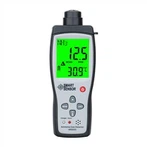
Measurement methods and practical applications of anemometers
Positioning of Anemometers in Air Flow
The correct adjustment position of the rotary probe of the anemometer is that the airflow direction is parallel to the rotary axis. When the probe is gently rotated in the airflow, the reading will change accordingly. When the reading reaches its maximum value, it indicates that the probe is in the correct measurement position. When measuring in a pipeline, the distance from the starting point of the straight part of the pipeline to the measurement point should be greater than 0XD, and the influence of turbulence on the thermal sensitive probe and pitot tube of the anemometer is relatively small.
Anemometer measurement of airflow velocity in pipelines
Practice has proven that the 16mm probe of the anemometer is the most widely used. Its size ensures good permeability and can withstand flow rates up to 60m/s. The measurement of airflow velocity in pipelines is one of the feasible measurement methods, and the indirect measurement regulation (grid measurement method) is applicable to air measurement.
Square cross-section gate, measuring ordinary specifications
Circular cross-section gate, measuring the specifications of the centroid axis
Circular cross-section gate, measuring range linear specifications
Measurement of Anemometers in Exhaust Gas Extraction
The ventilation port will greatly change the relatively balanced distribution of airflow in the pipeline: a high-speed zone will be generated on the surface of the free ventilation port, while the rest will be a low-speed zone, and vortices will be generated on the grid. According to different design methods of the grid, the airflow cross-section is relatively stable at a certain distance (about 20cm) in front of the grid. In this case, measurements are usually made using the caliber wheel of a high wind speed instrument. Because larger apertures can average uneven flow rates and calculate their average values over a larger range.
The anemometer is measured using a volumetric flow funnel at the exhaust port:
Even without the interference of a grid at the suction point, the air flow path has no direction, and its airflow cross-section is extremely uneven. The reason for this is the local vacuum inside the pipeline, which funnels the air out into the air chamber. Even in the area close to the extraction, there is no location that meets the measurement conditions for measurement operations. If the grid measurement method with average value calculation function is used for measurement, and the volumetric flow method is used to determine the volumetric flow rate, only the pipeline or funnel measurement method can provide repeatable measurement results. In this case, measuring funnels of different sizes can meet the usage requirements. By using a measuring funnel, a fixed cross-section that meets the flow velocity measurement conditions can be generated at a certain distance in front of the disc valve. The center of the cross-section can be measured and fixed, and the center of the cross-section can be measured and fixed here. The measured value obtained by the flow rate probe is multiplied by the funnel coefficient to calculate the extracted volumetric flow rate.