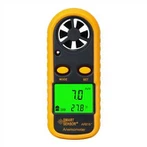
Measuring method and application of anemometer and thermal anemometer
Measuring method and application of anemometer and thermal anemometer
An instrument for measuring air velocity. There are many types of it, and the most commonly used one in meteorological stations is the wind cup anemometer, which consists of three parabolic cone empty cups fixed on the bracket at 120° to each other to form the sensing part, and the concave surfaces of the empty cups are all in one direction. The whole induction part is installed on a vertical rotating shaft, and under the action of wind force, the wind cup rotates around the shaft at a speed proportional to the wind speed. Another rotary anemometer is the propeller anemometer, which consists of a three-bladed or four-bladed propeller as the sensing part, which is installed on the front end of a wind vane so that it is always aligned with the direction of the wind. The blades rotate around a horizontal axis at a speed proportional to the wind speed. Commonly used anemometer types are: an anemometer made by using the heat dissipation rate of the heated object and the wind speed correlation principle; an ultrasonic anemometer made by using the principle that the sound wave propagation speed is affected by the wind speed and thus increases and decreases.
Probe Selection for Anemometers
The flow velocity measurement range from 0 to 100m/s can be divided into three sections: low velocity: 0 to 5m/s; medium velocity: 5 to 40m/s; high velocity: 40 to 100m/s. The thermal probe of the anemometer is used for the measurement of 0 to 5m/s; the rotating wheel probe of the anemometer is ideal for measuring the flow velocity of 5 to 40m/s; and the pitot tube can get the best results in the high speed range. (Shanghai Yiou Instrument Equipment Co., Ltd.) An additional criterion for the correct selection of the flow rate probe of the anemometer is temperature. Usually, the operating temperature of the thermal sensor of the anemometer is about +-70C. The rotor probe of the special anemometer can reach 350C. Pitot tubes are used above +350C.