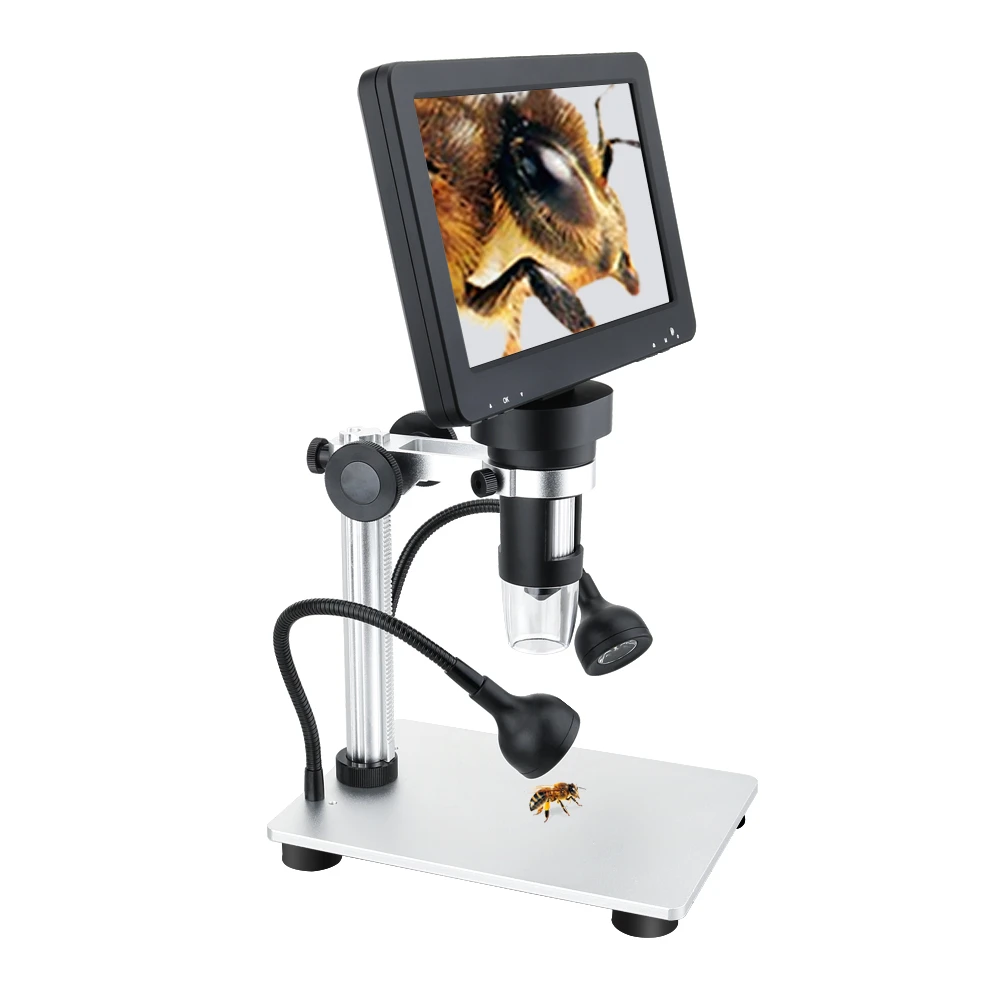
Mechanical components of a microscope
(1) Mirror base: The mirror base is the basic support of the microscope, which consists of two parts: the base and the mirror arm. It consists of two parts: the base and the mirror arm. It is connected with the carrier stage and the mirror tube, which is used to install the foundation of the optical magnification system components. The base and mirror arm play a role in stabilising and supporting the whole microscope.
(2) lens barrel: the lens barrel connected to the eyepiece, connected to the lower converter, forming a darkroom between the eyepiece and the objective lens (mounted under the converter). The distance from the rear edge of the objective lens to the end of the barrel is called the mechanical barrel length. Because the magnification of the objective lens is for a certain barrel length. A change in the length of the barrel not only changes the magnification with it, but also affects the quality of the image. Therefore, when using a microscope, you can not arbitrarily change the length of the lens barrel. Internationally, the standard length of the microscope tube is 160mm, and this number is usually marked on the housing of the objective lens. There are two types of barrels: monocular and binocular; monocular barrels are divided into upright and tilted barrels, while binocular barrels are tilted barrels.
(3) Objective converter: Objective converter can be installed on three to four receiving lenses, generally three receiving lenses (low magnification, high magnification and oil lenses). Turn the converter, can be required to one of the receiving lens and lens barrel alignment (note that the rotation of the conversion for the selection of lenses, can not grasp the lens of the objective lens to turn), with the eyepiece to constitute a magnification system.
(4) carrier stage: carrier stage in the centre of a hole, for the light channel. On the stage is equipped with a spring specimen clip and pusher, its role is to fix and move the position of the specimen, so that the object is located in the centre of the field of vision.
(5) pusher: is to move the specimen mechanical device, it is by a horizontal and vertical two propulsion tooth axis of the metal frame, good microscope in the longitudinal and transversal frame pole engraved with a graduated scale, constitute a very precise plane coordinate system. If we need to repeat a part of the observation, you can note down the value of the vertical and horizontal scale, and then move to the same value can be found.
(6) coarse adjusting handwheel (coarse spiral): coarse adjusting handwheel is a rapid movement to adjust the distance between the objective lens and specimen.
(7) micro-adjustment handwheel (fine spiral): coarse adjustment handwheel can only be roughly adjusted focus, to get the clearest object
To get the sharpest object, you need to use the macro screw to do fine adjustment.