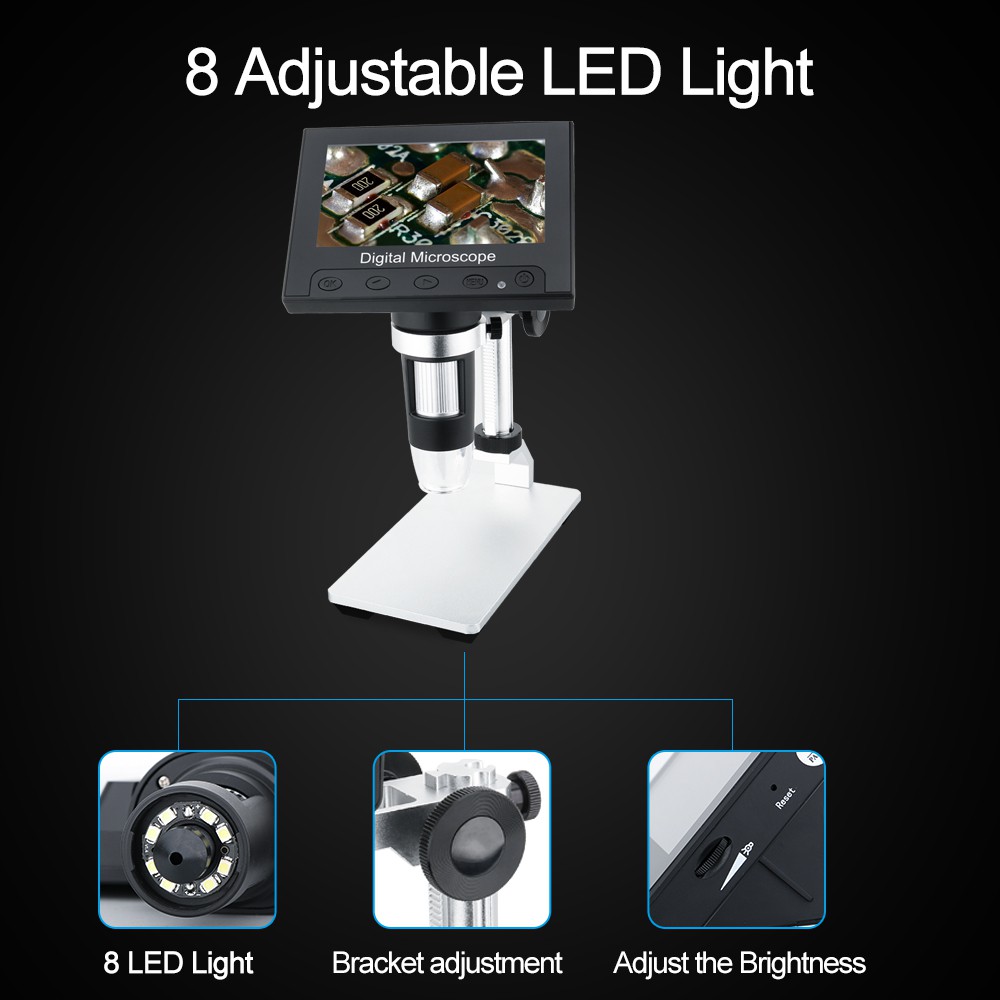
Metallurgical microscope inspection of cemented carbide porosity implementation standards
Metallurgical microscope detection of cemented carbide porosity implementation standard is GB/T 3489-2015 cemented carbide porosity and non-chemical carbon metallographic determination. Detection steps are as follows:
1, the * size of the pores on the grinding surface is set as the size of the pores.
2, less than or equal to 10um of porosity, in the magnification of 100 or 200 times under the observation of the grinding surface of the specimen, assessment.
3, greater than 10um less than 25um porosity, in the metallurgical microscope magnification 100 times to observe the grinding surface of the specimen, and its assessment.
4, such as the need to test the porosity greater than 25um, should be put under the metallurgical microscope size is greater than or equal to 100 times the appropriate magnification under the test.
5, such as if the porosity or non-chemical carbon, in the test of the metallographic specimen grinding surface distribution is not uniform, it is necessary to identify the location of the
Location, such as: top, top, edge (shell) and centre.
There are relatively many methods of testing rock chip and core porosity. In logging, logging while drilling, microscopic examination of rock chips, and nuclear magnetic resonance (NMR) analyses can measure rock chip and core porosity. In logging, compensated neutron, compensated density, and acoustic time difference logging are commonly used to measure porosity, and some universities and research institutes have also developed special equipment to measure the porosity of rock chips. Drill-time logging and microscopic examination of rock chips have the disadvantages of not being quantitative and having large errors, while nuclear magnetic resonance (NMR) analyses have the disadvantages of high cost and cumbersome operation; logging is carried out after the formation of the borehole and the presentation of the drilling tool, with a relative lag in the time of measurement; and the equipment developed by universities and scientific research institutes is relatively high in cost and complex in structure. The Russian rock chip and core density porosity measuring instrument, which has the advantages of simple operation, easy-to-understand principle, low cost, easy maintenance, wide applicability, and real-time performance, is necessary as a supplement to the existing methods.
Soil porosity definition
Various shapes of coarse and fine soil particles in the soil collection and arranged into a solid-phase skeleton, the skeleton within the width and shape of the pore, constituting a complex pore system, all the pore volume accounted for the percentage of the volume of the soil body, known as the soil porosity.
Experimental steps
(1) Use a ring knife with a volume of Vt, use the ring knife matching handle, chipping knife with the sample, that is, the soil volume is Vt;
(2) Remove the soil sample and weigh the wet weight ms' of the soil sample using an electronic balance;
(3) Dry the soil sample using heat drying, alcohol scorching and freeze drying;
(4) Calculate the size of the water content of the soil sample: w=(ms'-ms)/ms×100%;
(5) Place the dried dry soil sample into a measuring cylinder containing water and measure the dry soil sample volume Vs using the principle of the drainage method;
(6) Calculate the soil bulk density D and density d from equations (1) and (2);
(7) Calculate the soil porosity from equation (3) on the basis of soil weight and density calculation.