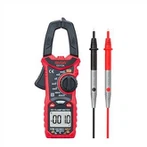
Methods for measuring semiconductors using digital multimeters and pointer multimeters
The use of digital multimeters has become very popular, but in common electrical technology books, the measurement method for semiconductors mostly uses pointer multimeters, and the use of digital multimeters is rarely introduced. The methods of measuring semiconductors with a digital multimeter and a pointer multimeter are different.
1, Diode
The open circuit voltage of the diode range of the digital multimeter is about 2.8V, with the red probe connected to the positive terminal and the black probe connected to the negative terminal. The current provided during measurement is about 1mA, and the displayed value is the approximate forward voltage drop of the diode, measured in mV or V. The forward conduction voltage drop of a silicon diode is approximately 0.3~0.8V. The forward conduction voltage drop of germanium diode is about 0.1~0.3V. And the forward voltage drop of diodes with higher power is smaller. If the measured value is less than 0.1V, it indicates that the diode has broken down, and both forward and reverse directions are conducting at this time. If both the forward and reverse directions are open, it indicates that the PN node of the diode is open. For light-emitting diodes, when measured in the forward direction, the diode emits light with a voltage drop of about 1.7V.
2, Transistor
A transistor has two PN nodes, the emitter node (be) and the collector node (bc), which can be measured using the method of measuring diodes. In actual measurement, the forward and reverse voltage drop should be measured between every two pins, a total of 6 times. Among them, 4 times show an open circuit, and only 2 times show the voltage drop value. Otherwise, the transistor is broken or a special transistor (such as a resistive transistor, Darlington transistor, etc., which can be distinguished from a common transistor by model). In two measurements with numerical values, if the black or red probe is connected to the same pole, then that pole is the base, the smaller measurement value is the collector node, and the larger measurement value is the emitter node. Since the base has been identified, the collector and emitter can be determined accordingly. At the same time, it can be determined that if the black probe is connected to the same pole, the transistor is PNP type, and if the red probe is connected to the same pole, the transistor is NPN type; Silicon tubes have a voltage drop of around 0.6V, while germanium tubes have a voltage drop of around 0.2V.
3, Thyristor
The anode, cathode, and control electrode of the thyristor are open circuits, which can be used to determine the anode pin and determine whether the thyristor has broken down. There is also a PN node between the thyristor control electrode and the cathode, but there is a protective resistor between the high-power thyristor control electrode and the cathode, and the displayed value during measurement is the voltage drop across the resistor.
4, Optocoupler
One side of the optocoupler is a light-emitting diode, with a voltage drop of about 1V during measurement. The other side is a transistor, some of which only lead out c e, Measure both forward and reverse directions with cutoff. If all three pins are connected, the measurement characteristics will be the same as those of the above transistor (mostly NPN transistor). When using a multimeter to make the diode conduct in the forward direction, use another multimeter to measure the voltage drop between transistor c and e, which is about 0.15V; Disconnect the multimeter connected to the diode, and if transistor C is turned off to E, it indicates that the optocoupler is functioning properly.