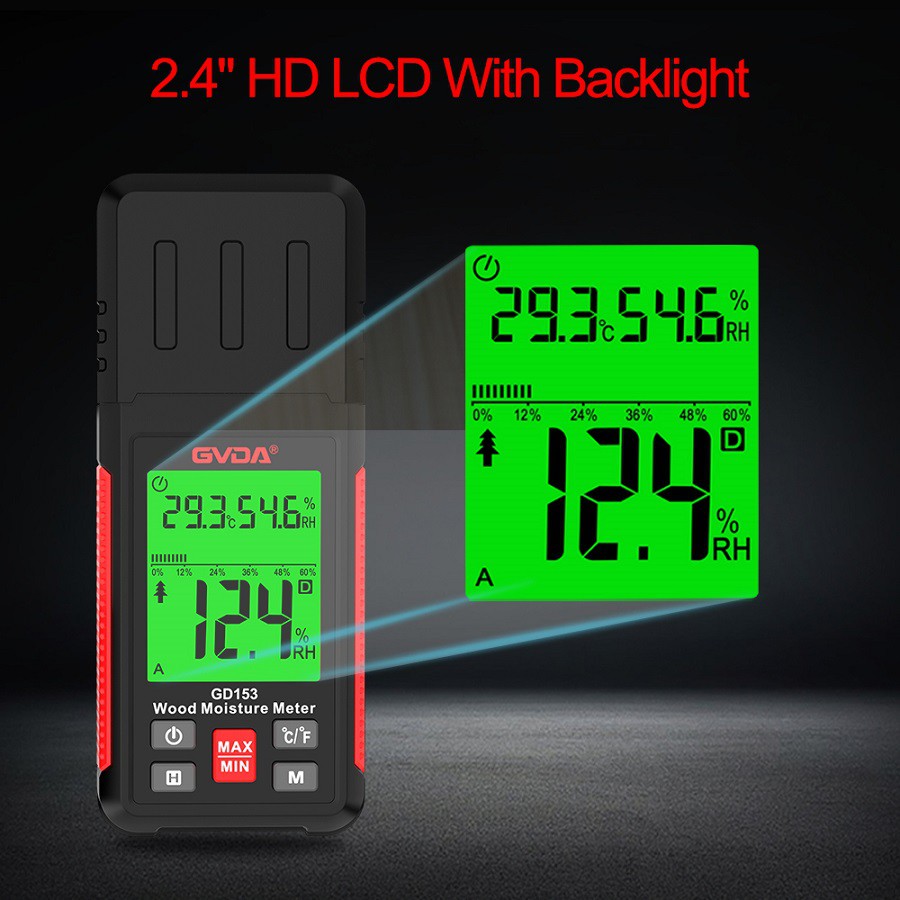
Moisture meters serve as a replacement for traditional moisture measurement methods.
In the history of instrument development, humans have continuously explored from traditional manual instruments to modern scientific instruments. The methods for measuring the moisture content of objects are constantly improving, and it seems that there was no such thing as a moisture measuring instrument in the early days. The initial moisture measurement was carried out by drying and then manually calculating the moisture content based on the formula of the weight loss method: [moisture content=[mass of the object before weight loss - mass of the object after weight loss)/mass of the object before weight loss]. However, the moisture content calculated by this method is very inaccurate and the measurement results are easily affected by various factors, resulting in unstable measurement data.
Driven by industrial technological innovation, after the mid-20th century, with the emergence of automatic control theory and the maturity of automatic control technology, digital moisture meters based on A/D (digital/analog conversion) links developed rapidly. With the rapid development of computers, communication, software, new materials, and technologies, mature artificial intelligence and online measurement have become possible, leading moisture measuring instruments towards intelligence, digitization, and automation. Moisture meters have been widely used in various industries in recent years, and traditional moisture measuring instruments and methods with large measurement errors are gradually being phased out.
Moisture meters can be widely used in all industries that require rapid determination of moisture, such as pharmaceuticals, grains, feed, seeds, rapeseed, dehydrated vegetables, tobacco, chemical industry, tea, food, meat, textile, agriculture and forestry, papermaking, rubber, plastic, textile and other industries in laboratories and production processes, while meeting the requirements for determining the moisture content of solids, particles, powders, gelatinous bodies and liquids.
In the process of using a moisture analyzer, we need to pay attention to the fact that the titration results can be input and output in a certain required format, and the moisture analyzer can automatically perform relevant statistics and analysis, so that our moisture analyzer can obtain relevant data in a timely manner. When using a rapid moisture analyzer, not only should we know its technical characteristics, but there are also many things to pay attention to, so the titration speed should be fast and accurate.
Moisture meters should avoid direct sunlight, vibration, and other situations as much as possible. There should also be no temperature interference or power fluctuations. Sufficient space should be left around the instrument for heat dissipation to prevent inaccurate measurement caused by heat source accumulation. The distance between the instrument and the tested substance should be maintained. During use, it should be noted that the ventilation opening of the instrument should not be covered or filled with other items, as this is very dangerous. When starting to heat up, flammable materials should not be placed around the instrument to avoid injury to the operator. In addition, the weight of the measured material sample should be minimized as much as possible, which helps to improve the accuracy of the detection results.