Multimeter electrical blocking range and measurement error
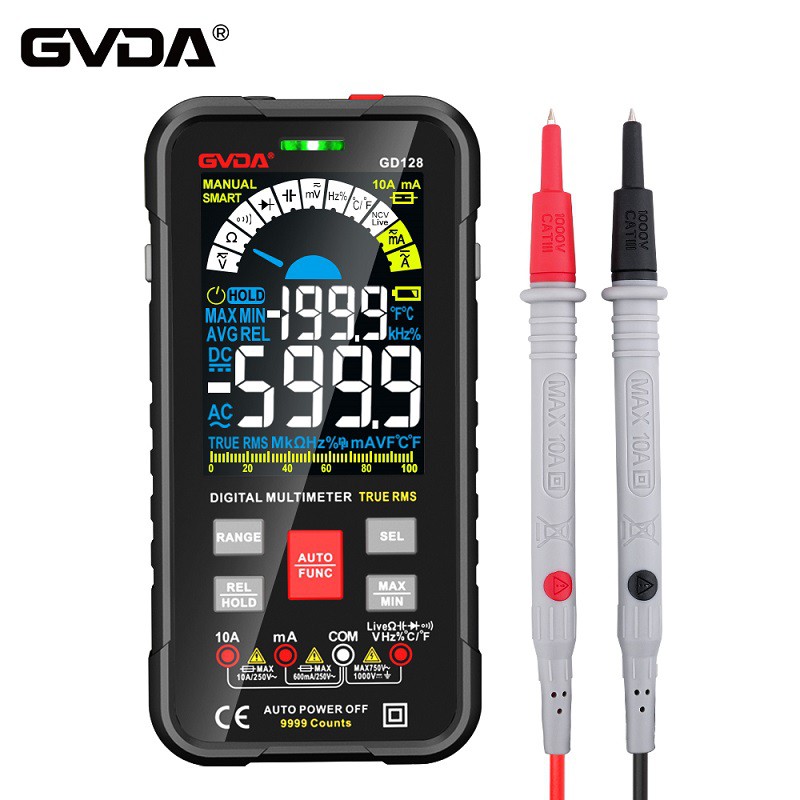
Multimeters have many uses. They can be used to measure resistance, voltage, etc. When using the electrical resistance of a multimeter to measure resistance, let's take a look at how to choose the electrical resistance range of the multimeter and how to reduce the measurement error.
Taking an MF-30 multimeter as an example, the center resistance of the Rxl0 block is 250Ω, the center resistance of the R×l00 block is 2.5kΩ, and the accuracy level is 2.5.
Use R×l0 gear and R×100 gear to measure a 500Ω standard resistance. Which gear has a larger measurement error?
1. R×l0 block: Maximum absolute allowable error △R (10) = center resistance × R% = 250Ω × (±2.5)% = ±6.25Ω.
When measuring the 500Ω standard resistance, the indication value of the 500Ω standard resistance is between 493.75Ω and 506.25Ω. The maximum relative error is: ±6.25÷500Ω×100%=±1.25%.
2. R × l00 block: Maximum absolute allowable error △R (100) = center resistance × R% 2.5kΩ × (±2.5)% = ±62.5Ω.
When measuring the 500Ω standard resistance, the indication value of the 500Ω standard resistance is between 437.5Ω and 562.5Ω. The maximum relative error is: ±62.5÷500Ω×100%=±10.5%.
Result analysis:
Selecting different resistance ranges will result in large differences in measurement errors. So how can we reduce the measurement errors?
When selecting the gear range, try to keep the measured resistance value at the center of the arc length of the range scale to improve measurement accuracy and reduce measurement errors.
Multimeter electrical blocking
The electrical resistance range of a multimeter is very wide, and each range can be used to measure resistance values from 0 to ∞.
The formula for expressing the accuracy of electrical blocking of a multimeter is: R% = (△R/center resistance) × 100%.
The scale of the ohmmeter is a non-linear and uneven inverse scale, expressed as a percentage of the arc length of the scale. The internal resistance of each range is equal to the central scale multiplied by the arc length of the scale, which is called the "central resistance".
When the resistance being measured is equal to the center resistance of the selected range, the current flowing in the circuit is half of the full-scale current, and the pointer indicates the center of the scale.