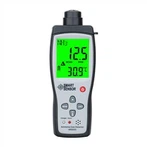
Multimeter to check the quality of field effect tube
Use a multimeter Rxlk to measure the forward and reverse resistance values between any two pins of the field-effect transistor. If the resistance value is small twice or more, the field-effect transistor is damaged; If only one small resistance value occurs (usually in the hundreds of ohms), and the remaining measured resistance values are infinite, further judgment is needed. Measure the forward and reverse resistance values between the drain and source using the Rxlk range of a multimeter. For an N-channel transistor, connect the red probe to the source and touch the gate with the black probe first. Measure the forward and reverse resistance values between the drain and source. If both the forward and reverse resistance values are 0 Ω, the transistor is considered good. For a P-channel transistor, connect the black probe to the source and the red probe to touch the gate first. Measure the forward and reverse resistance values between the drain and source. If both resistance values are 0 Ω, the transistor is good; otherwise, it indicates damage.
Tip: Some field-effect transistors have protective diodes connected between the gate and source, and the above detection methods are not applicable.
① Using the Rx100 gear, measure the forward and reverse resistance values between any two pins of the field-effect transistor. When the red probe is connected to pin 2 and the black probe is connected to pin 3, the multimeter reading is 8000. If the multimeter reading is infinite multiple times, then pin 1 is the gate.
② Measure the resistance between the drain and source using Rxl0K mode. Connect the red probe to pin 2 and the black probe to pin 3. At this point, the multimeter reading is 0.3xl0K Ω; When the red probe of the multimeter is connected to pin ③ and the black probe is connected to pin ②, and the reading of the multimeter is 0, the red probe is connected to pin ③ as the source and the black probe is connected to the drain. Using the black probe to touch the gate is effective, indicating that this transistor belongs to the N-channel transistor.