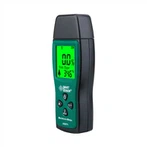
Multimeter usage tips
1. Use a multimeter to judge the quality of piezoelectric ceramics
Piezoelectric ceramics are a synthetic piezoelectric material. When subjected to external pressure, charges will be generated on both sides, and the amount of charge is proportional to the pressure. This phenomenon is called piezoelectric effect. Piezoelectric ceramics have a piezoelectric effect, that is, they will deform under the action of an external electric field, so piezoelectric ceramic sheets can be used as sounding components.
Utilizing the piezoelectric effect of the piezoelectric ceramic sheet, a multimeter can be used to judge whether it is good or bad.
Lead out two wires from the two poles of the piezoelectric ceramic sheet, then place the ceramic sheet flat on the table, connect the two lead wires to the two test leads of the multimeter respectively, turn the multimeter to the minimum current position, and then lightly press the ceramic sheet with the rubber tip of a pencil. If the pointer of the multimeter swings obviously, it means that the ceramic chip is intact, otherwise, it means it is damaged.
2 Use a multimeter to judge the positive and negative poles of the speaker
First, turn the pointer multimeter to the DC 0-5mA gear, and then connect the two test leads to the two soldering pieces of the speaker to be tested. Press the paper cone of the speaker lightly with your hand, and observe the swing direction of the pointer of the multimeter. If the pointer deflects forward, the red test lead is connected to the negative pole of the speaker, and the black test lead is connected to the positive pole of the speaker. Conversely, the red test lead is connected to the positive pole, and the black test lead is connected to the negative pole.
3. Maintenance of weighbridges and electronic scales using multimeter skills
The use of digital multimeter 1. How to use
1. Before use, read the relevant instruction manual carefully, and be familiar with the functions of the power switch, range switch, jack, and special jack.
2. Put the power switch in the ON position.
3. Measurement of AC and DC voltage: Turn the range switch to the appropriate range of DCV (direct current) or ACV (alternating current) as required, insert the red test lead into the V/Ω hole, insert the black test lead into the COM hole, and connect the test lead to the circuit under test in parallel , the reading is displayed.
4. Measurement of AC and DC current: Turn the range switch to the appropriate range of DCA (DC) or ACA (AC), insert the red test lead into the mA hole (<200mA) or 10A hole (>200mA), and insert the black test lead into the COM hole , and connect the multimeter in series in the circuit under test
. When measuring DC flow, the digital multimeter can automatically display the polarity.
5. Resistance measurement: Turn the range switch to the appropriate range of Ω, insert the red test lead into the V/Ω hole, and insert the black test lead into the COM hole. If the measured resistance value exceeds the maximum value of the selected range, the multimeter
The meter will display "1" and a higher range should be selected. When measuring resistance, the red test lead is positive and the black test lead is negative, which is just the opposite of the pointer multimeter. Therefore, when measuring polar components such as transistors and electrolytic capacitors, attention must be paid to the
polarity.