Multimeter use in instrument repair
Attention should be paid to the use of multimeters:
1). Identify the function of each file of the multimeter.
2). Measure three to four resistances and record them.
3). Measure the AC voltage and record it.
4). Measure the DC voltage and record it.
Multimeter: Mainly used to measure AC and DC voltages. current. DC resistance, and transistor current amplification digits, etc. There are mainly two types of digital multimeters and mechanical multimeters that are common now.
1) Digital multimeter
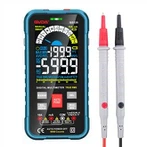
On the multimeter, you will see the conversion knob as shown in the figure, and the knob refers to the gear of the secondary quantity.
V~: Indicates the gear for measuring AC voltage.
V-: Indicates the gear for measuring DC voltage.
MA: Indicates the gear for measuring DC voltage.
Ω(R): Indicates the range of measuring resistance.
HFE: Indicates the scale of measuring resistance.
The red pen of the multimeter indicates that it is connected to the positive pole of the external circuit, and the black pen indicates that it is connected to the negative pole of the external circuit.
Advantages: Antimagnetic. The reading is convenient and accurate (digital display).
2) Mechanical multimeter
The appearance of a mechanical multimeter is somewhat different from that of a digital meter, but the gear knobs of the two are similar, and the gear positions are basically the same.
On the mechanical watch, you will see a dial as shown in the figure, and there are eight scales on the dial:
The one marked with "Ω" is the scale used for measuring resistance.
The ones marked with "~" are for AC and DC voltage measurement. A scale used for direct current.
The one marked with "HFE" is the scale used when measuring the triode.
Marked with "LI" is the measured load current. Voltage scale.
Marked "DB" is a scale for measuring levels.
3) Use of multimeter
①Digital multimeter: Before measuring, switch to the measurement position. It should be noted that the range marked on the position is the maximum value.
②Mechanical multimeter: The method of measuring current and voltage is the same as the mathematical formula, but when measuring the cathode, the reading must be multiplied by the value on the gear to get the measured value. For example: the current gear is "X100" and the reading is 200, the measurement is 200X100=20000Ω=20K, the scale of "Ω" on the dial is from left to right, from large to small, while others are from left to right ,From small to large
4). Precautions:
① Adjust the "zero point" (only for mechanical watches). Before using the watch, first check that the pointer is on the "zero position" at the left end. If not, you should slowly turn the "start zero position" in the center of the case with a small screwdriver Correct the screw so that the pointer points to the zero position.
②When the multimeter is used, it should be placed horizontally (only for machinery)
③Before the test, determine the measurement content, turn the range conversion knob to the corresponding gear for the measurement shown, so as not to burn the meter head, if you do not know the size of the measured physical quantity, start the test with a large range first.
④The test leads should be correctly inserted into the corresponding sockets.
⑤During the test, do not rotate the gear change knob arbitrarily.
⑥ After use, be sure to adjust the gear change knob of the unused meter to the maximum range gear of the AC voltage.
⑦ When measuring DC voltage and current, pay attention to the positive and negative poles of the voltage, the flow direction of the current, and the correct connection (when) with the test leads.