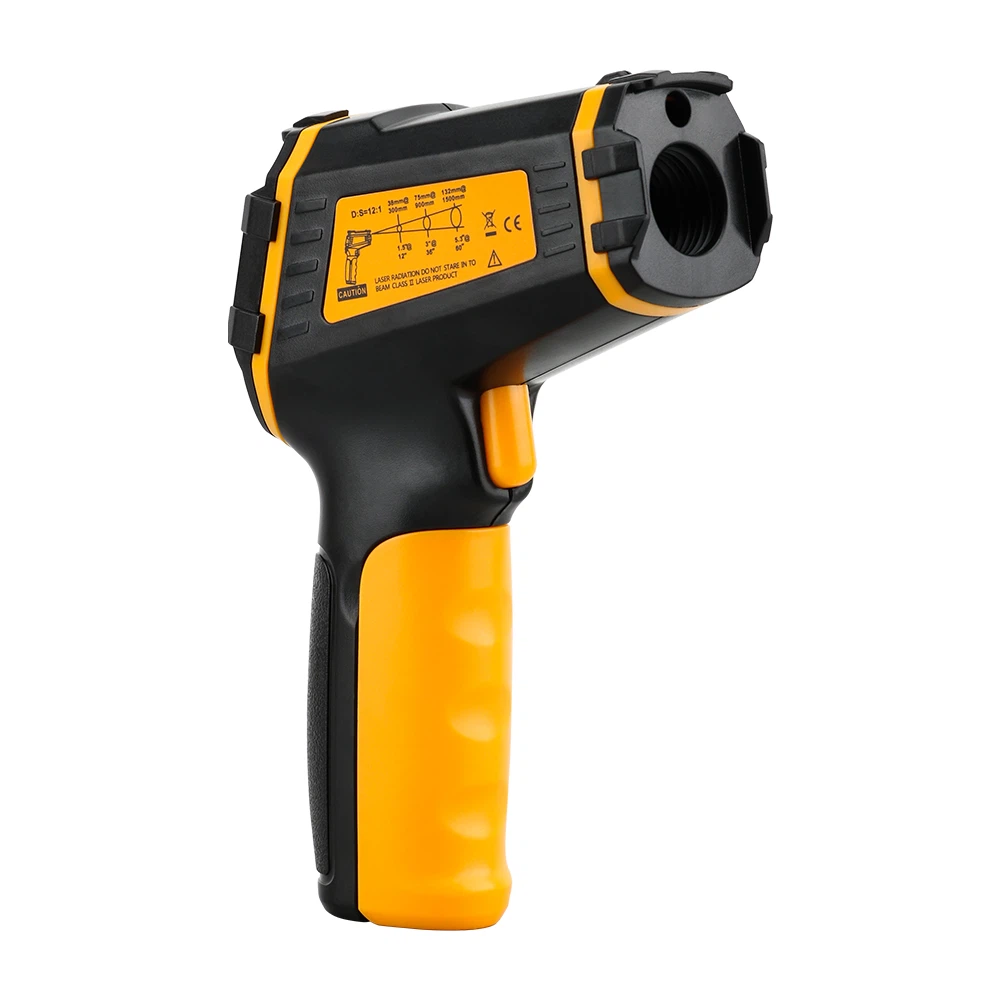
Non-Contact Infrared Thermometers Advantages and Applications
Infrared is a kind of electromagnetic wave, with radio waves and visible light of the same nature, its wavelength between 0.76-100μm.
All temperatures higher than absolute zero (-273.15K °) above the object, will be due to their own molecular movement and constantly radiate infrared radiation to the surrounding space, the size of the object's infrared radiation energy and its distribution according to the wavelength, and its surface temperature has a very close relationship.
Infrared thermometer by measuring the lightness of the object emitting infrared radiation energy, through the optical system in the detector and will be converted into an electrical signal, according to the size of the electrical signal to calculate the surface temperature of the object, the infrared thermometer in the measurement of the whole process of non-contact measurements, is also known as the "non-contact infrared thermometer".
Infrared thermometer S11 consists of sensors, optical systems and electronic circuits and jointly integrated in a metal housing, it is the wavelength of infrared radiation energy in the 8μm-14μm, the temperature of the object between 0 ~ 500 ℃, non-contact high-precision measurement.
Technical advantages of infrared thermometer:
High precision: advanced optical lens is selected, with a fixed emissivity of 0.95, 15:1 optical resolution, 500ms (95%) response time to quickly detect small changes in temperature, high-precision measurements of the object, and a more stable 4~20mA output signal.
Easy to install: the device is integrated and integrated, the shape is solid, lightweight and easy to install, the standard thread on the metal shell can be quickly connected with the installation parts, easy to install and use.
High protection level: infrared thermometer using 24VDC operating voltage, protection level of IP65, can be applied to a variety of harsh working environments, so that the monitoring work is easier and safer.
Infrared thermometer can measure the surface temperature of casting, furnace temperature, machine parts, glass, room temperature, human body, coal, power systems and other objects, in industry, construction, civil and other industries are very widely used.