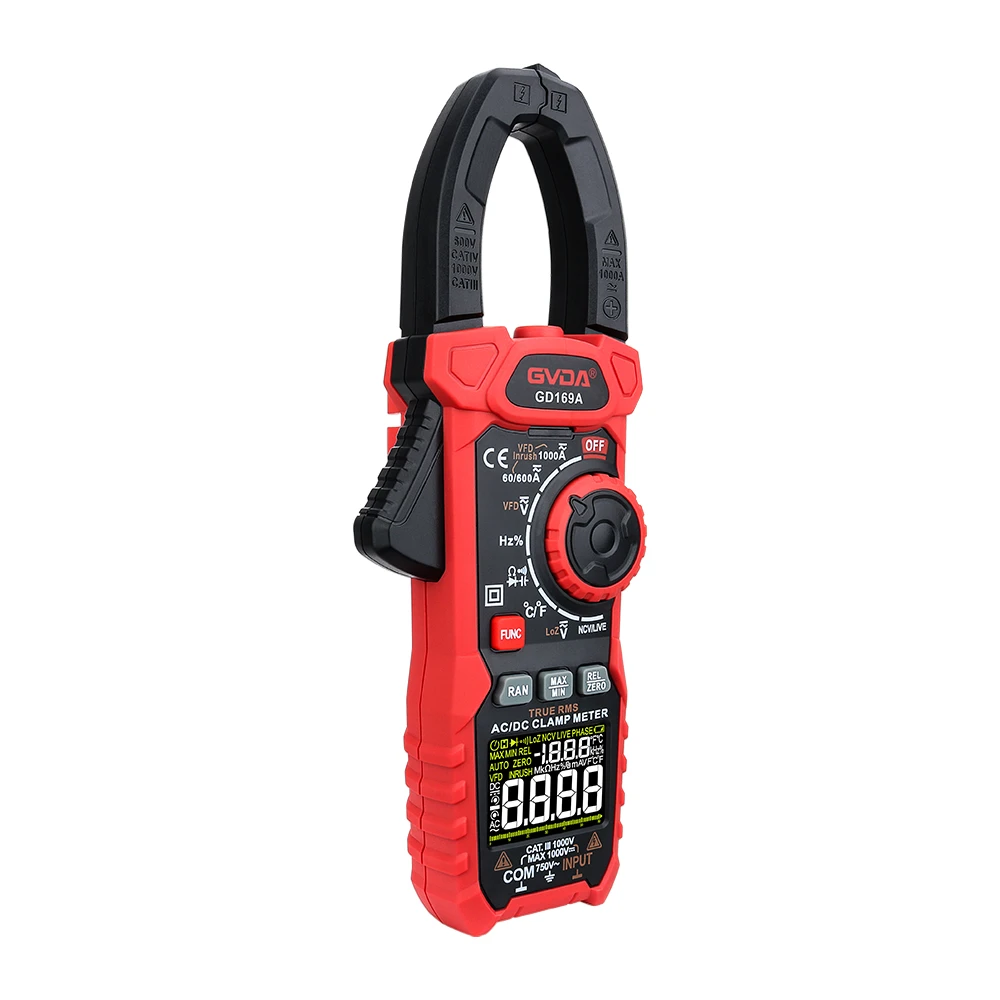
Operating Methods for Clamp Meters
① First, select the correct voltage class of the clamp ammeter, and check whether its external insulation is in good condition without damage, whether the pointer swings freely, and whether the jaws are free of rust. Select the measuring range according to the rated current estimated from the power of the motor.
② Read the user manual carefully before using the clamp ammeter to confirm whether it is an AC-only or AC/DC dual-purpose clamp meter.
③ Since clamp ammeters generally have low accuracy, the following method can be adopted for measuring small currents: wind the test circuit wire several turns, then place it inside the jaws of the clamp meter. The reading shown on the meter is not the actual measured value. The actual current equals the reading of the clamp meter divided by the number of wire turns.
④ The jaws of the clamp meter must close tightly during measurement. If noise occurs after closing, open and re-close the jaws. If the noise persists, check whether the contact surfaces of the magnetic circuit are clean; wipe off dust and dirt if present.
⑤ A clamp meter can only measure the current of one conductor at a time. The tested conductor shall be placed at the center of the clamp window. Do not put multiple phase conductors into the window for measurement.
⑥ The voltage of the circuit under test must not exceed the rated value marked on the clamp meter. Otherwise, earth fault or electric shock hazard may occur.
⑦ Measure the operating current of the squirrel-cage induction motor. The operating condition of the motor can be checked and judged according to the current value to ensure safe operation and extend service life.
⑧ During measurement, each phase can be measured separately, or the three phases can be measured together; in the latter case, the reading shall be zero (the vector sum of three-phase currents is zero). When two phase wires are placed inside the jaws, the displayed reading is the current of the third phase. The measured phase currents can be used to judge whether the motor is overloaded (if the measured current exceeds the rated current), whether there is an internal motor fault, or whether the three-phase current unbalance exceeds the limit of 10%.