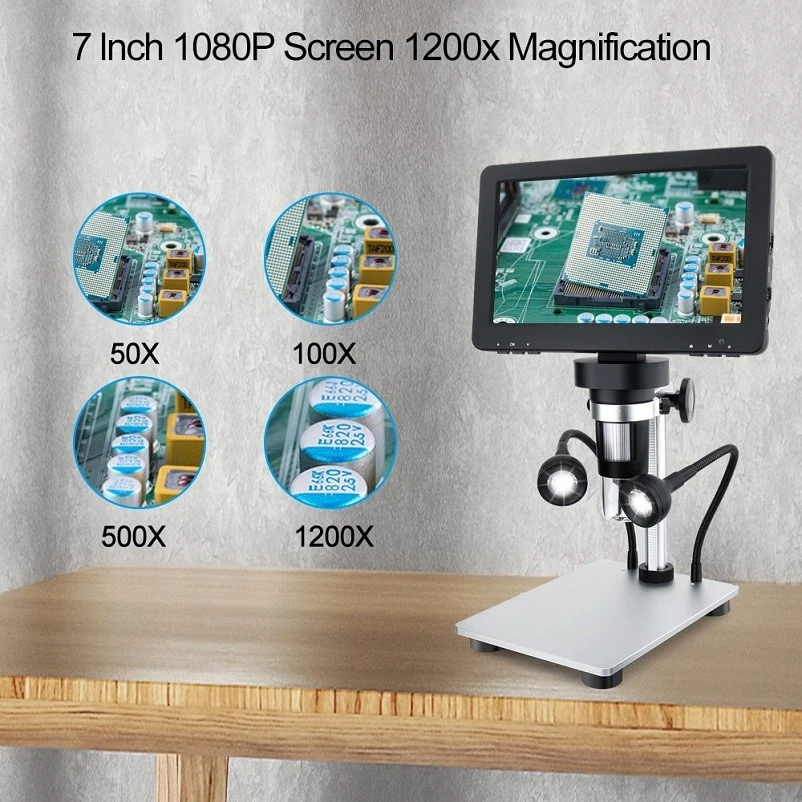
Optical microscope operating procedures and precautions
1. Hold the mirror arm with your right hand and hold the mirror base with your left hand to keep the mirror body upright. The desktop should be clean and stable, and should be placed near a window or in a well-lit place. The single tube is usually placed on the left side, 3 to 4 cm away from the edge of the table.
2. Cleaning Check whether there is any problem with the microscope and whether it is clean. The mechanical part of the mirror body can be wiped with a clean soft cloth. The lens should be wiped with lens cleaning paper. If there is glue or dirt, use a small amount of xylene to clean it.
3. Raise the focusing tube to a position 1 to 2 centimeters away from the stage, and align the low-power lens with the clear aperture. Adjust the aperture and reflector. Use a flat mirror when the light is strong, and a concave mirror when the light is weak. Use both hands to turn the reflector. If you are using a microscope with a light source, you can omit this step, but you will need a knob to adjust the brightness.
4. Install the specimen and place the slide on the stage. Note that the side with the cover slip must be facing up. Fix the glass slide with a spring clip and turn the knob of the platform mover to align the material to be observed with the center of the light hole.
5. When adjusting the focus, first rotate the coarse focusing knob to slowly lower the lens barrel, and observe carefully from the side until the objective lens is close to the slide specimen, then observe with the left eye through the eyepiece, and rotate the coarse focusing knob with the left hand to raise the lens barrel. Stop until you can see the specimen image clearly, and then use the fine focus knob to adjust it back to clarity. Operation note: Do not adjust the focus directly under high magnification; when the lens tube is lowered, observe the distance between the lens tube and the specimen from the side; you must understand the critical value of the object distance. If a binocular microscope is used, if the visual acuity of the observer's eyes is different, the visual acuity adjustment ring can be used to adjust it. In addition, the binoculars can be moved relative to each other to adapt to the distance between the operator's eyes.
6. If you use a monocular microscope for observation, open your eyes naturally, observe the specimen with your left eye, observe, record and draw with your right eye, and adjust the focus with your left hand to make the object image clear and move the field of view of the specimen. The right hand records and draws. During microscopic examination, the specimen should be moved into the field of view in a certain direction until the entire specimen is observed, so that no inspection is missed or repeated. Adjustment of light intensity: Under normal circumstances, the light for dyed specimens should be strong, and the light for colorless or unstained specimens should be weak; the light for low-power observation should be weak, and the light for high-power observation should be strong. In addition to adjusting the reflector or light source, the adjustment of the iridescent aperture is also very important.