Optical microscope usage steps and maintenance
1. Hold the mirror arm with your right hand and hold the mirror base with your left hand to keep the mirror body upright. The desktop should be clean and stable, and should be placed near a window or in a well-lit place. The single tube is usually placed on the left side, 3 to 4 cm away from the edge of the table.
2. Cleaning Check whether there is any problem with the microscope and whether it is clean. The mechanical part of the mirror body can be wiped with a clean soft cloth. The lens should be wiped with lens cleaning paper. If there is glue or dirt, use a small amount of xylene to clean it.
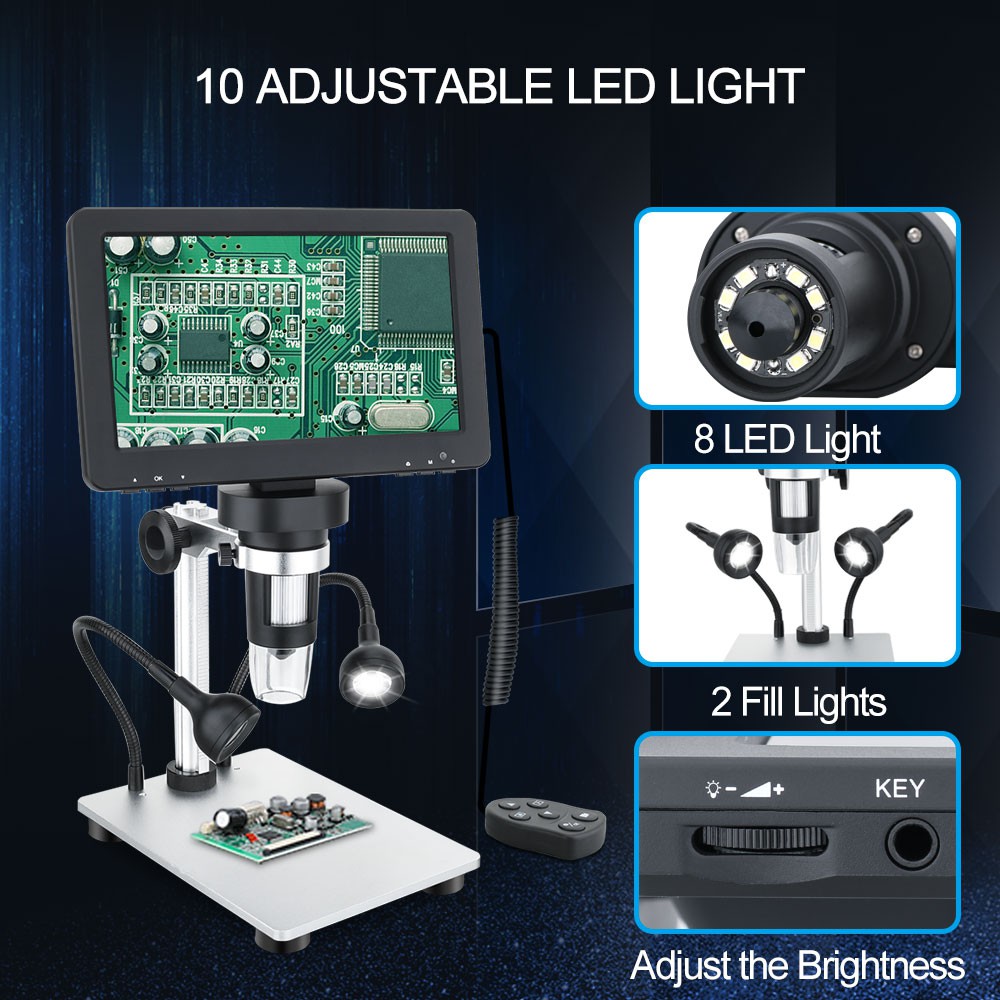
3. Raise the focusing tube to a position 1 to 2 centimeters away from the stage, and align the low-power lens with the clear aperture. Adjust the aperture and reflector. Use a flat mirror when the light is strong, and a concave mirror when the light is weak. Use both hands to turn the reflector. If you are using a microscope with a light source, you can omit this step, but you will need a knob to adjust the brightness.
4. Install the specimen and place the slide on the stage. Note that the side with the cover slip must be facing up. Fix the glass slide with a spring clip and turn the knob of the platform mover to align the material to be observed with the center of the light hole.
5. When adjusting the focus, first rotate the coarse focusing knob to slowly lower the lens barrel, and observe carefully from the side until the objective lens is close to the slide specimen, then observe with the left eye through the eyepiece, and rotate the coarse focusing knob with the left hand to raise the lens barrel. Stop until you can see the specimen image clearly, and then use the fine focus knob to adjust it back to clarity. Operation note: Do not adjust the focus directly under high magnification; when the lens tube is lowered, observe the distance between the lens tube and the specimen from the side; you must understand the critical value of the object distance. If a binocular microscope is used, if the visual acuity of the observer's eyes is different, the visual acuity adjustment ring can be used to adjust it. In addition, the binoculars can be moved relative to each other to adapt to the distance between the operator's eyes.
6. If you use a monocular microscope for observation, open your eyes naturally, observe the specimen with your left eye, observe, record and draw with your right eye, and adjust the focus with your left hand to make the object image clear and move the field of view of the specimen. The right hand records and draws. During microscopic examination, the specimen should be moved into the field of view in a certain direction until the entire specimen is observed, so that no inspection is missed or repeated. Adjustment of light intensity: Under normal circumstances, the light for dyed specimens should be strong, and the light for colorless or unstained specimens should be weak; the light for low-power observation should be weak, and the light for high-power observation should be strong. In addition to adjusting the reflector or light source, the adjustment of the iridescent aperture is also very important.
7. End the operation. After the observation is completed, remove the sample, rotate the converter so that the lens is V-shaped on both sides, the reflector should be upright, lower the lens barrel, wipe it clean, and put on the lens cover. If you are using a microscope with a light source, you need to adjust the brightness knob to the darkest level and then turn off the power button to prevent excessive current from burning out the light source when you turn it on next time.
1. Daily maintenance
(1) Moisture-proof optical lenses are prone to mold and fogging. Mechanical parts are prone to rust when exposed to moisture. 1 to 2 bags of silica gel should be placed in the microscope box as a desiccant.
(2) Dust falling on the surface of dust-proof optical components not only affects the passage of light, but also creates large stains after amplification by the optical system, affecting observation. Dust and sand falling into mechanical parts will also increase wear and hinder movement, which is also very harmful. Take care to keep the microscope clean.
(3) Anti-corrosion microscopes cannot be placed together with corrosive chemical reagents. Such as sulfuric acid, hydrochloric acid, strong alkali, etc.
(4) Heat protection to prevent the lens from opening and falling off due to thermal expansion and contraction. Therefore, the biological microscope should be placed in a dry, cool, dust-free, and corrosion-free place. After use, wipe it clean immediately, cover it with a dust-proof breathable cover or put it in a box. When the microscope is not in use, cover it with a plastic cover and store it in a dry place to prevent dust and mildew. Store objectives and eyepieces in a container such as a desiccator with some desiccant.
2. Maintenance of the sliding parts of the mechanical system: Apply some neutral grease regularly to clean the paint and plastic surfaces: Stubborn stains can be cleaned with a soft detergent. It is recommended to use silicon cloth. Plastic part: Use a soft cloth dipped in water to clean. Note: Do not use organic solvents (such as alcohol, thinner, etc.). Because it will corrode machinery and paint, causing damage.
3. Maintenance of the optical system and cleaning of the lens. Gently wipe the eyepiece and objective lens with a clean and soft silk cloth after use. The condenser and reflector only need to be wiped clean. If there are more stubborn stains, you can use long-fiber absorbent cotton or clean fine cotton cloth dipped in a little xylene or lens cleaning fluid to wipe it, and then wipe it dry with a clean soft silk cloth or blow dry with a hair dryer.
Note: The cleaning fluid must not penetrate into the objective lens, otherwise it will damage the objective lens. Pure alcohol and xylene burn easily, so be especially careful not to ignite these liquids when turning the power switch on or off. To deal with mold and fog on the objective lens and eyepiece, prepare 30% absolute ethanol + 70%. Place different lenses in separate desiccant containers. It is best to wipe them with cotton swabs, gauze, soft brushes and other soft things. The oil lens needs to be cleaned at that time. Especially for 100X oil lenses, if not handled properly, the front lens may be easily soaked in oil or peel off. The eyepiece can be removed and cleaned by yourself. Be careful not to install the 16X eyepiece upside down, with the concave surface of the front piece facing up. Do not remove the objective lens casually. Note: When scrubbing the lens, do not use excessive force to prevent damage to the coating layer. Generally, it is best to perform intensive maintenance once every 2 months. When there are many microscopes, each lens should be numbered to avoid mismatching.
4. Regular inspection In order to maintain stable performance, it is recommended to conduct regular inspection and maintenance.
To sum up, for the maintenance of biological microscopes, it is mainly dust-proof, moisture-proof, heat-proof and corrosion-proof. Clean and wipe clean in time after use, and add neutral lubricating grease to relevant parts regularly. For some parts with complex structure and precise assembly, they cannot be disassembled and assembled without authorization without certain professional knowledge, skills and special tools to avoid damaging the parts.