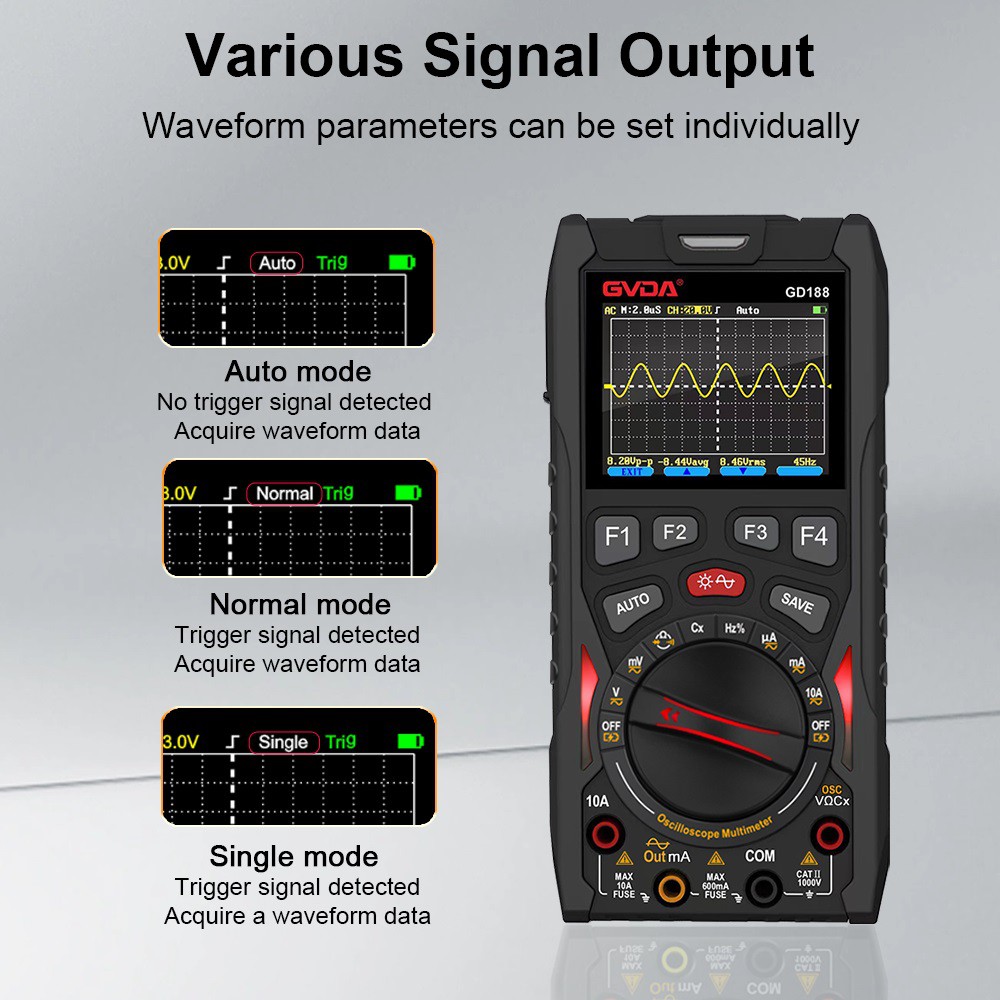
Oscilloscope Amplitude and Frequency Measurement Methods
Measurement methods of amplitude and frequency (taking the calibration signal of an oscilloscope as an example)
Insert the oscilloscope probe into the channel 1 jack and set the attenuation on the probe to level 1;
Set the channel selection to ch1 and the coupling mode to dc;
Insert the probe tip into the small hole of the calibration signal source, and a light trace will appear on the oscilloscope screen;
Adjust the vertical knob and horizontal knob to make the waveform displayed on the screen stable, and place the vertical fine-tuning and horizontal fine-tuning in the calibration position;
Read out the number of grids occupied by the waveform in the vertical direction and multiply it by the indicated value of the vertical attenuation knob to obtain the amplitude of the calibration signal;
Read out the number of grids occupied by each period of the waveform in the horizontal direction, and multiply it by the indicated value of the horizontal scan knob to obtain the period of the calibration signal (the reciprocal of the period is the frequency);
Generally, the frequency of the calibration signal is 1khz and the amplitude is 0.5v. It is used to calibrate the frequency of the oscilloscope's internal scanning oscillator. If it is abnormal, the corresponding potentiometer of the oscilloscope (internal) should be adjusted until it matches.
Tips for using the oscilloscope:
For a general-purpose oscilloscope, adjust the brightness and focus knobs to minimize the diameter of the light spot to make the waveform clear and reduce the test error; do not make the light spot stay at one point, otherwise the electron beam will bombard a point and form dark spots on the fluorescent screen, damaging the fluorescent screen.
Measurement systems - such as oscilloscopes, signal sources; printers, computers and other equipment. The ground wire of the electronic equipment under test - such as instruments, electronic components, circuit boards, power supplies of the equipment under test, etc. must be connected to the public ground (earth).
When the TDS200/TDS1000/TDS2000 series digital oscilloscope is used with a probe, it can only measure the waveform of the signal (the measured signal - the signal ground is the earth, and the output amplitude of the signal terminal is less than 300VCATII). It is absolutely not possible to measure AC220V mains power or floating signals of electronic equipment that cannot be isolated from AC220V mains power. (Floating ground cannot be connected to the ground, otherwise it will cause damage to the instrument, such as testing an induction cooker.)
The shell of the general oscilloscope, the metal outer ring of the BNC socket at the signal input end, the ground wire of the probe, and the ground wire end of the AC220V power socket are all connected. If the instrument is used without a ground wire and directly uses a probe to measure floating signals, the instrument will produce a potential difference relative to the ground; the voltage value is equal to the potential difference between the point where the probe ground wire contacts the equipment under test and the ground. This will bring serious safety risks to instrument operators, oscilloscopes, and electronic equipment under test.
If you need to measure switching power supplies (switching power supply primary, control circuit), UPS (uninterruptible power supply), electronic rectifiers, energy-saving lamps, frequency converters and other types of products or other electronic equipment that cannot be isolated from the mains AC220V for floating signal testing , the DP100 high-voltage isolated differential probe must be used.