Practical knowledge and selection guide of range finder
As the name implies, the laser range finder uses laser as the main working substance to work. At present, the working substances of the handheld laser rangefinder on the market mainly include the following types: semiconductor lasers with a working wavelength of 905 nm and 1540 nm, and YAG lasers with a working wavelength of 1064 nm. The wavelength of 1064 nanometers is harmful to human skin and eyes, especially if the eyes are accidentally exposed to the laser with a wavelength of 1064 nanometers, the damage to the eyes may be huge. Therefore, in foreign countries, the 1064 nanometer laser is completely banned in the handheld laser rangefinder. In China, some manufacturers also produce 1064nm laser rangefinders.
For 905nm and 1540nm laser rangefinders, we call them "safe". For the 1064nm laser range finder, because it has potential hazards to the human body, we call it "unsafe".
Laser range finder, because laser is used for distance measurement, and the pulsed laser beam is a monochromatic light source with very concentrated energy, so when using it, do not look directly at the emission port with your eyes, and do not observe the smooth reflective surface with an aiming telescope to avoid Harm to human eyes. Be sure to measure according to the safe operation specification in the instrument manual. When measuring in the field, do not point the launch port of the instrument directly at the sun to avoid burning out the photosensitive element of the instrument.
Rangefinder Selection Guide
Here are a few things to consider when purchasing a rangefinder:
1. Measuring range
2. Measurement accuracy
3. Where to use
It is basically divided into the following situations:
a) It only needs to measure the distance within a few meters or more than ten meters,
And when the accuracy requirement is not high.
*Suggestion - "ultrasonic range finder" can be selected.
*Remarks——The measurement effect of the ultrasonic rangefinder is greatly affected by the environment, and its stability and directionality are worse than those of the laser rangefinder, but the price is relatively cheap! Suitable for indoor measurements.
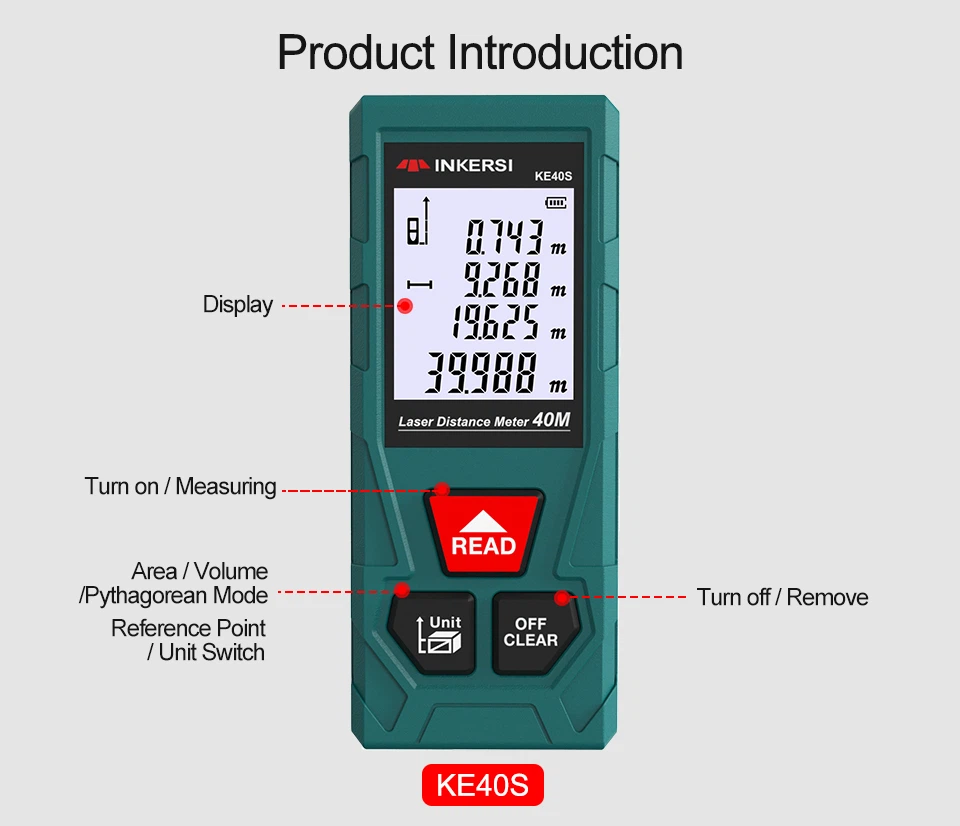
b) The measurement distance is not long, and it is mostly used indoors, with high precision requirements!
*Suggestion - you can choose "Handheld Laser Rangefinder".
*Remarks——The handheld laser rangefinder is most suitable for indoor use, and the measurement accuracy and effect are very good!
(If the user needs to detect in an outdoor environment, it is recommended to use a professional laser sight and a reflector to achieve the expected range and effect.)
c) The measurement distance is relatively long, and it is mostly used for outdoor use!
*Suggestion - buy "telescopic laser rangefinder" (ie: laser rangefinder telescope)
* Features - it is both a telescope and a rangefinder! With multiple observation magnifications, the user can easily aim at the target for distance measurement only through the cross sight system inside the eyepiece! It can accurately measure the target distance by using the transparent infrared laser that is harmless to the eyes. It is small in size, light and easy to carry!
e) Measuring long-distance and outdoor measurements
*Suggestion - buy a built-in telescope so that you can see more clearly under strong light.
*Remarks——It is convenient for accurate measurement.
Problems that need to be paid attention to when using the laser range finder: The laser range finder cannot be aimed at the human eye for direct measurement to prevent damage to the human body. At the same time, the general laser rangefinder is not waterproof, so you need to pay attention to waterproofing.