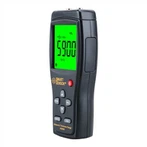
Principle of measurement, types and calibration of illuminance meters
Illuminance Meter Measuring Principle.
Photovoltaic cell is a photoelectric element that directly converts light energy into electrical energy. When the light to the surface of the selenium photovoltaic cell, the incident light through the metal film 4 to reach the semiconductor selenium layer 2 and the metal film 4 on the dividing surface, in the interface photoelectric effect. Generate the size of the potential difference with the photocell light on the surface of the illumination has a certain proportion. At this time, if connected to an external circuit, there will be a current through the current value from the lux (Lx) as the scale of the microampere meter to indicate out. The magnitude of the photocurrent depends on the intensity of the incident light and the resistance in the circuit. The illuminance meter has a shift device, so it can measure high illuminance and low illuminance. Cited the type of illuminance meter: 1. visual illuminance meter: inconvenient to use, high precision, rarely used 2. photoelectric illuminance meter: commonly used selenium photoelectric cell illuminance meter and silicon photoelectric cell illuminance meter
Types of illuminance meter.
1. Visual illuminance meter: inconvenient to use, not high precision, rarely used
2. photoelectric illuminance meter: commonly used selenium photoelectric cell illuminance meter and silicon photoelectric cell illuminance meter
Composition and use of photocell illuminance meter requirements.
1. Composition: microampere meter, shift knob, zero adjustment, terminal, photocells, V (λ) correction filter and other components.
Commonly used selenium (Se) photocells or silicon (Si) photocells illuminance meter, also known as lux meter.
2. Use requirements.
① photocell application of good linearity of selenium (Se) photocells or silicon (Si) photocells; long working hours can still maintain good stability, and high sensitivity; high E when the choice of high internal resistance photocells, its low sensitivity and good linearity, not easily damaged by bright light irradiation
② paid within the V (λ) correction filter, suitable for illuminance with a different color temperature light source, the error is small
③ photocell before the addition of a cosine angle compensator (opal glass or white plastic) because the incident angle is large, the photocell deviates from the cosine rule
④ illuminance meter should work at room temperature or near room temperature (photocell drift with the temperature change and change)
Calibration of illuminance meter.
Calibration principle.
Make Ls vertical irradiation photocell → E = I / r2, change r can be obtained under different illumination of the light current value, by E and i of the corresponding relationship between the current scale is converted to illumination scale.
Calibration method.
The use of light intensity standard lamp, in close proximity to the working distance of the point light source, change the distance between the photocell and the standard lamp l, recorded under the distance of the ammeter readings, by the inverse square law of distance E = I / r2 calculation of light illuminance E, which can be obtained from a series of different illuminance of the light current value of i, for the photocurrent i and the illuminance of the E curve of change, that is, for the illuminance of the calibration curve of the calibration curve of the illuminance of the illuminance can be made from the dial of the dial. This is the calibration curve of the illuminance meter.
Factors affecting the calibration curve.
Photocells and ammeter replacement needs to be re-calibrated; illuminance meter should be used for a period of time should be re-calibrated illuminance meter (generally within a year should be checked 1-2 times); high-precision illuminance meter can be used to check the light intensity of the standard lamp; expanding the range of illuminance meter can be changed in the range of the distance r, you can also choose a different standard lamps, the choice of a small range of the ammeter.