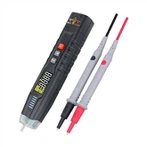
The introduction and working principle of illuminance meter
1. Illuminance meter:
Illuminance meter (or lux meter) is a specialized measurement of luminosity, brightness instrumentation. It consists of a host and a light sensor, the measurement range is (0-50000) lux, the average indoor light is (100-1000) lux, outdoor solar illumination is roughly 50000lux. lux is a unit of illumination, indicating the density of light irradiation on the surface. Its applications are mainly indoors, offices, laboratories, and environmental studies.
Is the degree to which the object is illuminated, that is, the surface of the object received by the luminous flux and the ratio of the illuminated area. Illuminance meter is usually composed of selenium photocell or silicon photocell and microampere meter.
2. Measurement principle:
Photocell is a photoelectric element that directly converts light energy into electrical energy. When light is directed to the surface of the selenium photovoltaic cell, the incident light passes through the metal film 4 to reach the demarcation surface of the semiconductor selenium layer 2 and the metal film 4, and produces a photoelectric effect at the interface. The size of the generated photogenerated current has a certain proportionality to the illumination on the light-receiving surface of the photocell. At this point, if an external circuit is connected, a current passes through, and the value of the current is indicated from a microampere meter graduated in lux (Lx). The magnitude of the photocurrent depends on the intensity of the incident light. The illuminance meter has a shift mechanism so that it can measure high illuminance as well as low illuminance.
Cite the type of illuminance meter: 1. visual illuminance meter: inconvenient to use, high precision, rarely used 2. photoelectric illuminance meter: commonly used selenium photoelectric cell illuminance meter and silicon photoelectric cell illuminance meter.