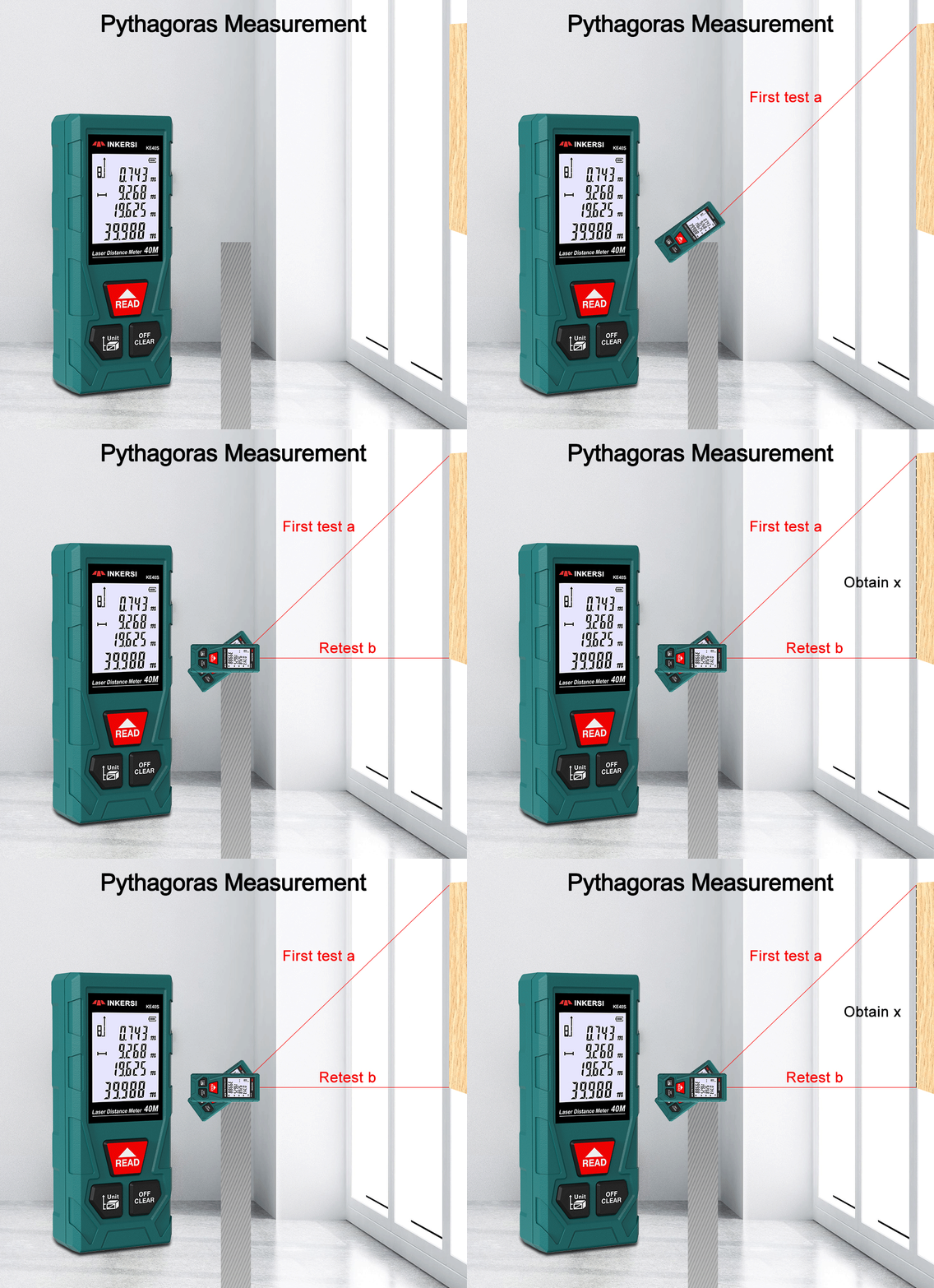
Rangefinder how to adjust the unit m
Press and hold that key below the plus and minus symbols which is the one on the left side of the bottom row and continue for a few seconds to change the unit once, every time you press the Pratt & Whitney Measurement X2.
A rangefinder is an instrument designed for distance measurement based on the principles of optics, acoustics and electromagnetic waves. A rangefinder is a trajectory projection instrument used to measure the distance to a target for trajectory projection. Rangefinders come in many forms, usually a long cylinder consisting of an objective lens, an eyepiece, and a range turning knob to determine target distance. A laser rangefinder is an instrument that utilizes a laser to accurately determine the distance to a target. Laser rangefinder in the work of a very thin beam of laser light to the target, by the photoelectric element to receive the target reflected laser beam, the timer to determine the laser beam from the time of launching to receiving, calculated from the observer to the target distance. Laser rangefinder is currently the most widely used rangefinder, laser rangefinder can be classified as handheld laser rangefinder (measuring distance 0-300 meters), telescope laser rangefinder (measuring distance 500-3000 meters).
Introduction to the distance measuring principle of the photoelectric rangefinder
Optical rangefinder according to the way of determining the time t, is divided into direct determination of time pulse ranging method and indirect determination of time phase ranging method. High-precision rangefinders generally use the phase type.
Phase-type photoelectric rangefinder distance measurement principle is: the light emitted by the light source through the modulator, the light intensity with the high-frequency signal changes in the modulated light. By measuring the modulated light in the distance to be measured back and forth propagation of the phase difference φ to solve the distance.
Phase method distance measurement is equivalent to the "light ruler" instead of a steel ruler to measure the distance, and λ / 2 for the length of the light ruler.
Phase type rangefinder, the phase meter can only measure the phase difference of the tail number ΔN, can not measure the whole cycle number N, so the distance is greater than the optical ruler can not be determined. In order to expand the range, a longer optical ruler should be selected. In order to solve the contradiction between expanding the range and ensuring accuracy, short-range rangefinders generally use two modulation frequencies, that is, two kinds of light ruler. For example: long light ruler (known as coarse ruler) f1 = 150kHz, λ1/2 = 1 000m, used to expand the range, the determination of 100 meters, ten meters and meters; short light ruler (known as fine ruler) f2 = 15MHz, λ2/2 = 10m, used to ensure the accuracy of the determination of meters, decimeters, centimeters and millimeters.