Searching for short circuit point with clamp ammeter
Searching for short circuit point with clamp ammeter
If several lighting branches share one fuse, it is more troublesome to find it by ordinary methods when a short circuit fault occurs.
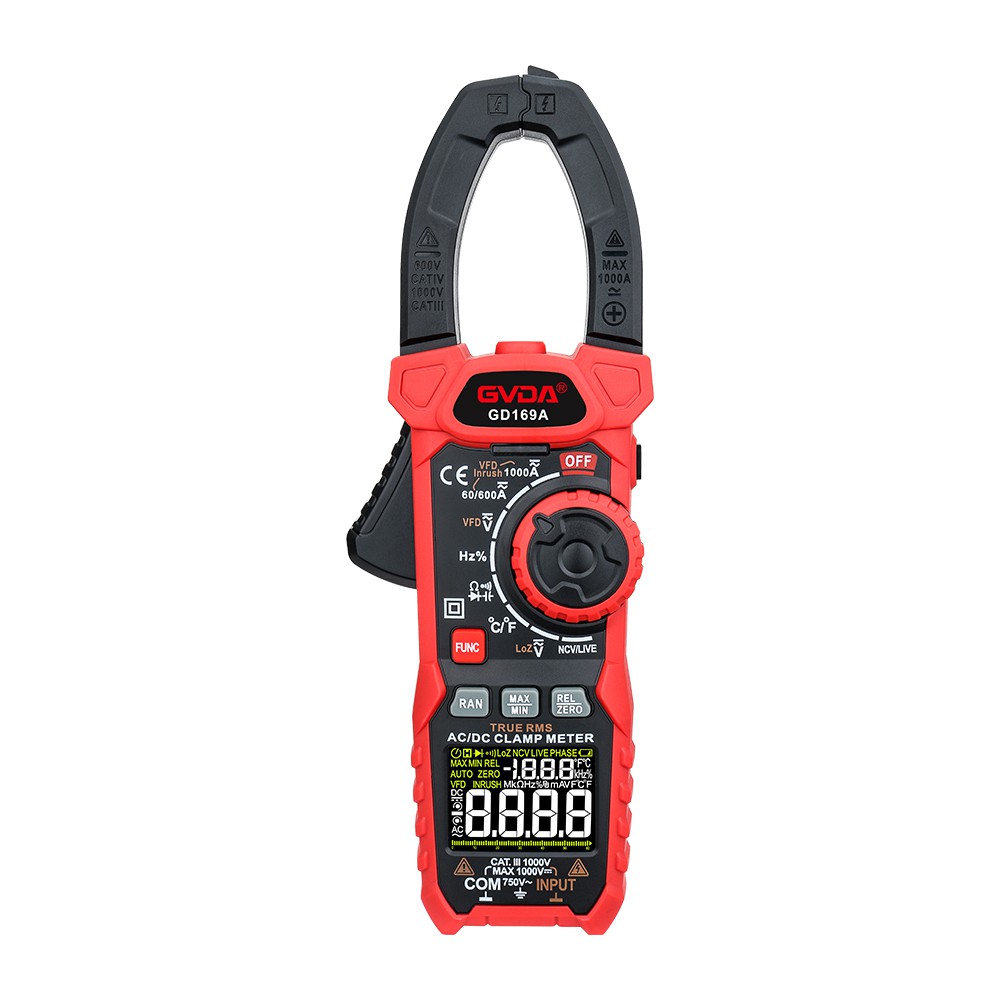
At this time, a 500W white light bulb can be connected to both ends of the blown fuse, and the incandescent lamp will shine when the power supply is turned on. Then clamp the branch with a small current (5A) of the clamp ammeter, and the branch with the maximum current is the short circuit. Then clamp the branch before and after lighting one by one to find the short circuit fault point. After the short-circuit fault is eliminated, the brightness of 500W incandescent lamp will be obviously weakened, indicating the fault elimination.
How to check short circuit, open circuit and leakage with multimeter?
How to check short circuit with multimeter?
"Short circuit" means that the two ends of the power supply are directly connected by wires. Using a multimeter to check the short circuit is actually to judge whether the line is connected or not by measuring the resistance. Because the multimeter resistance can not be measured with electricity, the resistance measurement must be carried out under the condition of power failure.
Judgment method:
1. First disconnect the power supply to ensure that there is no electricity, and then measure both ends of the measured object with the resistance of the multimeter. Under normal circumstances, there is a certain resistance. If the measured resistance is zero, it means that the measured object has a short circuit.
2. It is also possible to measure both ends of the measured object with the buzzer gear or diode gear of the multimeter in the case of power failure. If a sharp buzzer sounds, it means that the measured object has a short circuit.
Note: If the measured resistance has a certain value but is very small, it is probably a short circuit, which is caused by contact resistance.
We sometimes encounter this situation when measuring, for example, if you press the multimeter probe a little, the measured result will become smaller; Relax the stylus a little, and the result will be bigger. This is because the stylus and the measured wire are not connected well, and the contact resistance of the connection point is also measured.
In order to reduce the measurement error as much as possible and restore the authenticity of the results. Therefore, when measuring, the stylus and the wire of the measured object must be closely connected; If the conductor is seriously corroded or oxidized, the oxide layer on the conductor surface should be scraped off. (Under normal circumstances, copper is bright golden yellow, and it is dull black after being oxidized; The same is true for aluminum wires)
How to check the open circuit with multimeter?
After knowing how to measure short circuit with multimeter, it is very simple to measure open circuit.
Judgment method:
1. First disconnect the power supply to ensure that there is no electricity, and then measure the two ends of the line with the resistance of the multimeter. Under normal circumstances, the resistance is zero or has a certain resistance. If the measured resistance is infinite, it means that the two ends of the line are blocked, that is, an open circuit has occurred.
2. It is also possible to measure both ends of the line with the buzzer or diode of the multimeter in the case of power failure. If a buzzer sounds, the line is on; On the contrary, if there is no sound, it means that the tested line may have a short circuit.
Note: Under normal circumstances, the resistance at both ends of the wire is zero (or close to zero); Under normal circumstances, electrical equipment has a certain resistance, but the specific resistance is related to itself. Therefore, to judge whether the line or electrical equipment is open, it is best to use resistance to block a large range. Because some electrical equipment has a large resistance, such as energy-saving lamps, which can't be measured in a small range.