Several Common Types of Anemometers and Their Solutions
1. Hot-Wire Anemometer
A velocity-measuring instrument that converts flow velocity signals into electrical signals; it can also measure fluid temperature or density. Its working principle: a thin electrically heated metal wire (hot wire) is placed in the airflow. The heat dissipation of the hot wire in the airflow depends on the flow velocity. Heat loss changes the temperature of the hot wire and thereby its resistance, converting the flow velocity signal into an electrical signal. It has two operating modes: ① Constant-current mode: The current passing through the hot wire remains constant. Temperature variation changes the resistance of the hot wire, which leads to voltage variation across it, and the flow velocity is measured accordingly. ② Constant-temperature mode: The temperature of the hot wire is kept constant (e.g., maintained at 150°C). The flow velocity is quantified according to the current required to sustain this temperature. The constant-temperature mode is more widely used than the constant-current mode.
Hot wires generally have a length of 0.5–2 mm and a diameter of 1–10 μm, made of platinum, tungsten, platinum‑rhodium alloy, etc. If an extremely thin metal film (thickness less than 0.1 μm) replaces the metal wire, the device becomes a hot-film anemometer. It has similar functions to the hot-wire type but is mostly used for measuring liquid flow velocity. Besides the common single-wire configuration, hot wires can also be arranged as combined double-wire or triple-wire probes to measure velocity components in different directions. The electrical signal output from the hot wire is amplified, compensated and digitized before being sent to a computer. This improves measurement accuracy, enables automatic post-processing of data and expands velocity measurement capabilities, such as simultaneous measurement of instantaneous values and time-averaged values, resultant velocity and velocity components, turbulence intensity and other turbulence parameters. Compared with Pitot tubes, hot-wire anemometers feature small probe size, minimal disturbance to the flow field, fast response, capability to measure unsteady flow velocity, and the ability to measure very low velocities (as low as 0.3 m/s).
When a thermal probe is used in turbulent flow, airflow coming from all directions strikes the thermal element simultaneously and affects measurement accuracy. In turbulent flow measurements, readings from thermal anemometer velocity sensors are often higher than those from vane probes. This phenomenon can be observed during duct measurements and may occur even at low velocities depending on the design of turbulent ducts. Therefore, velocity measurements should be carried out on straight sections of ducts. The straight section shall start at least 10×D upstream of the measuring point (D = duct diameter in cm) and end at least 4×D downstream of the measuring point. The fluid cross-section must be free of any obstructions (corners, hangers, foreign objects, etc.).
2. Vane Anemometer
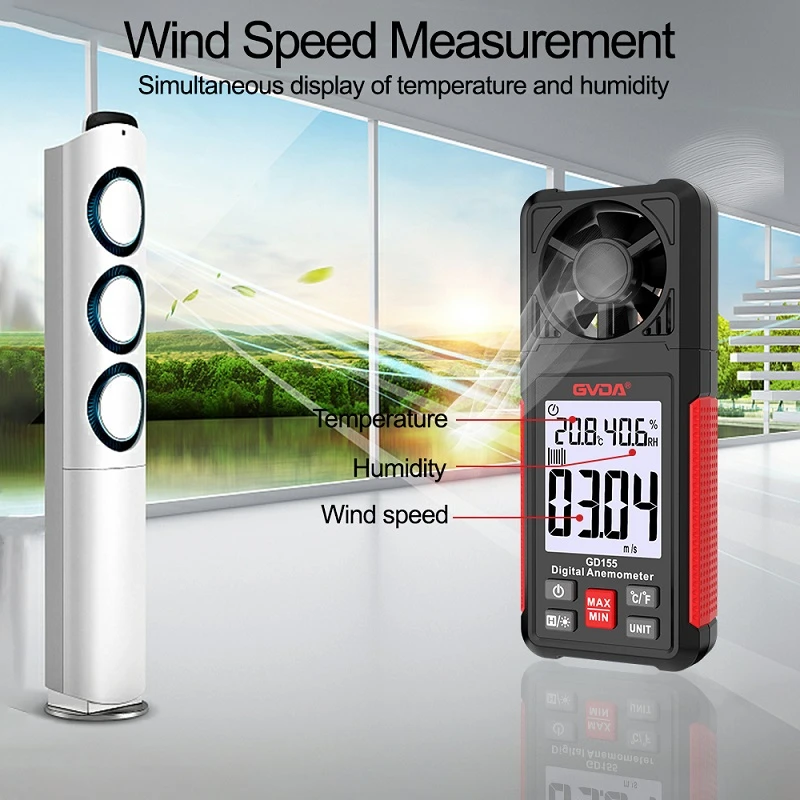
The working principle of the vane probe of this anemometer is based on converting rotation into electrical signals. A proximity switch counts the rotations of the vane and generates a pulse train. The tester processes these pulses to obtain the rotational speed. Large-diameter probes (60 mm, 100 mm) are suitable for measuring turbulent flow at medium and low velocities (e.g., at duct outlets). Small-diameter probes are more suitable for airflow inside ducts where the duct cross-sectional area is more than 100 times the probe cross-sectional area.