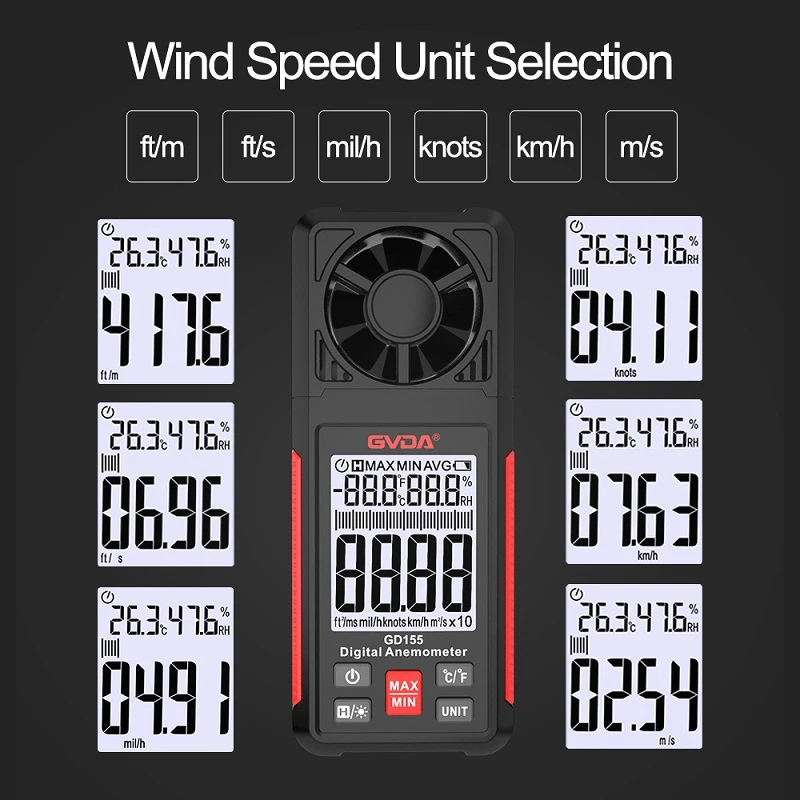
Using an Anemometer to Measure Air Volume and Air Velocity
An anemometer is an instrument for measuring air flow velocity. There are many types. Cup anemometers are commonly used at meteorological stations. They consist of three paraboloid cups mounted on a bracket at 120° to form the sensing assembly. The concave side of each cup faces the same direction. The entire sensing unit is installed on a vertical rotating shaft. Driven by wind, the cups rotate at a speed proportional to the wind speed. The following describes how to measure air volume and air velocity with an anemometer:
A. Air volume and wind speed tests shall be conducted first. All sampling measurements shall be carried out under the designed air volume and wind speed conditions.
B. Checking whether the fan runs normally before testing, and measuring the dimensions of the air duct and air outlet on site.
C. For unidirectional-flow (laminar-flow) cleanrooms, the air volume is determined by multiplying the average cross-sectional wind speed by the cleanroom area. (The cross-section perpendicular to the airflow downstream of the high-efficiency filter is taken as the sampling surface. The spacing between test points on the cross-section shall not exceed 0.6 m, with no fewer than 5 test points; the arithmetic mean of all readings is the average wind speed. For vertical unidirectional-flow (laminar-flow) cleanrooms, the measuring cross-section is 0.8 m ~ 1 m above the floor. For horizontal unidirectional-flow (laminar-flow) cleanrooms, the measuring cross-section is a vertical plane 0.5 m ~ 1 m away from the air supply face. There shall be no fewer than 10 test points on the cross-section, evenly distributed with spacing not greater than 2 m.)
D. For air outlets fitted with filters, calculate the air volume by multiplying the average wind speed at the outlet cross-section by the net outlet area. (Arranging no fewer than 6 evenly distributed test points on the cross-section of the air outlet or auxiliary duct to obtain the average wind speed.)
E. For air outlets with long branch ducts where drilling is permitted, the duct method can be used to determine air volume. (Drill holes at a position not less than 3 times the duct diameter or 3 times the maximum side length upstream of the outlet.)
F. For rectangular ducts, divide the measuring cross-section into several equal small sections, each preferably square with side length ≤200 mm, and place one test point at the center of each small section; the total number of test points on the cross-section shall not be less than 3. For circular ducts, divide the cross-section into annular zones by equal-area rings, drill holes on the outer duct wall at the test positions, insert a hot-wire anemometer probe or Pitot tube, and convert dynamic pressure readings into wind speed.