Using an Anemometer for Air Volume and Air Velocity Measurement
Using an Anemometer for Air Volume and Air Velocity Measurement
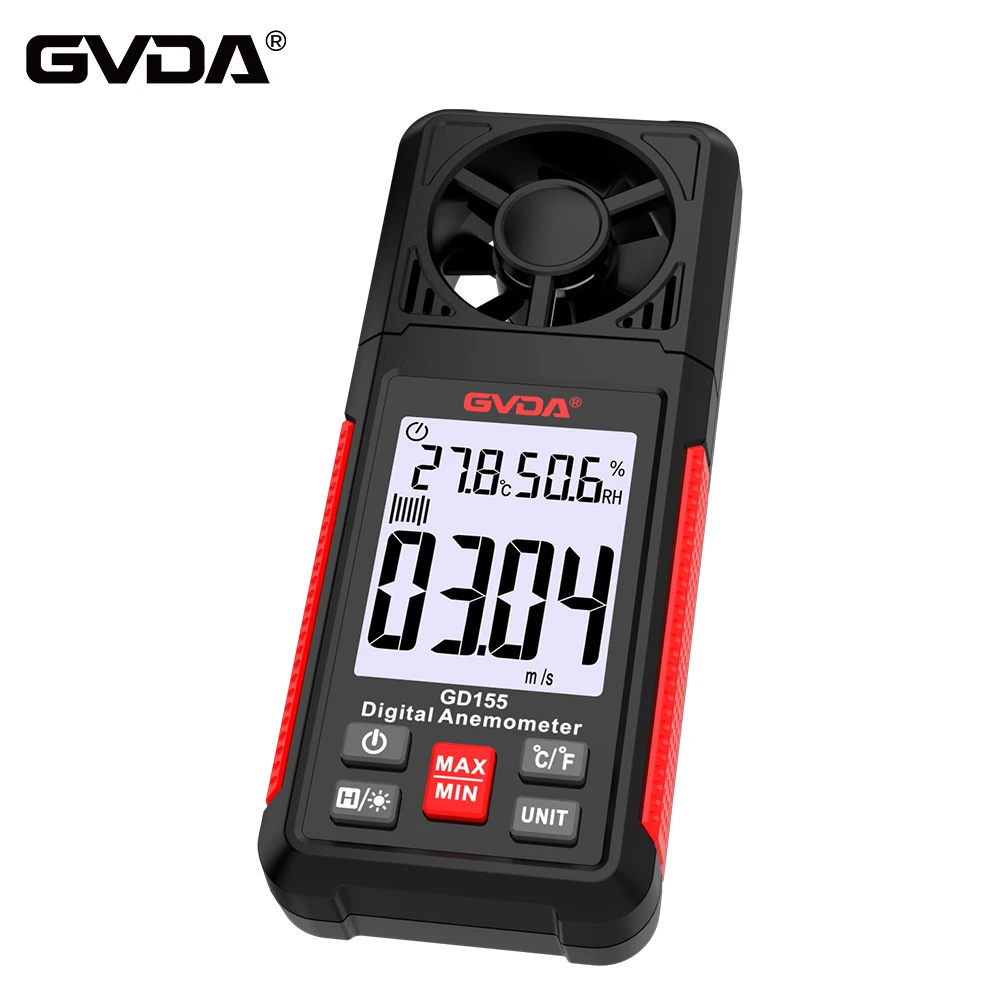
An anemometer is an instrument for measuring air flow velocity. There are many types. Cup anemometers are commonly used at meteorological stations. They consist of three paraboloid cups fixed on a bracket at 120° to form the sensing part. The concave sides of the cups all face the same direction. The whole sensing assembly is mounted on a vertical rotating shaft. Driven by wind, the cups rotate at a speed proportional to the wind speed. The following describes how users should use an anemometer to measure air volume and air velocity:
① Air volume and air velocity measurements shall be carried out first. All sampling points shall be taken under the designed air volume and wind speed.
② Checking whether the fan operates normally before testing. Measuring the size of air ducts and air outlets on site.
③ For unidirectional-flow (laminar-flow) clean rooms, calculating air volume by multiplying the average cross-sectional wind speed by the clean room area. (The cross-section away from the high-efficiency filter outlet and perpendicular to the airflow is taken as the sampling surface. Not more than 0.6 m between test points on the cross-section, with no fewer than 5 test points; the arithmetic mean of all readings is taken as the average wind speed. For vertical unidirectional-flow (laminar-flow) clean rooms, the measuring cross-section is 0.8 m ~ 1 m above the ground. For horizontal unidirectional-flow (laminar-flow) clean rooms, the measuring cross-section is a vertical cross-section 0.5 m ~ 1 m away from the air supply face. There shall be no fewer than 10 test points on the cross-section, with spacing not greater than 2 m and uniform distribution.)
④ For air outlets fitted with filters, determining air volume by multiplying the average wind speed at the air outlet cross-section by the outlet area. (Arranging no fewer than 6 evenly distributed test points on the cross-section of the air outlet or the auxiliary air duct to get the average wind speed.)
⑤ For air outlets with long branch ducts where drilling holes is feasible, using the air duct method to determine air volume. (Drilling holes at a position no less than 3 times the duct diameter or 3 times the maximum side length upstream of the air outlet.)
⑥ For rectangular ducts, dividing the measuring cross-section into several equal small sections, each as close to square as possible with side length not greater than 200 mm and the test point at the center of each small section; there shall be no fewer than 3 test points in total. For circular ducts, dividing the measuring cross-section into annular zones by equal-area rings, drilling holes on the outer wall of the air duct at the test points, and inserting a hot-wire anemometer probe or pitot tube. Converting the dynamic pressure reading into wind speed.