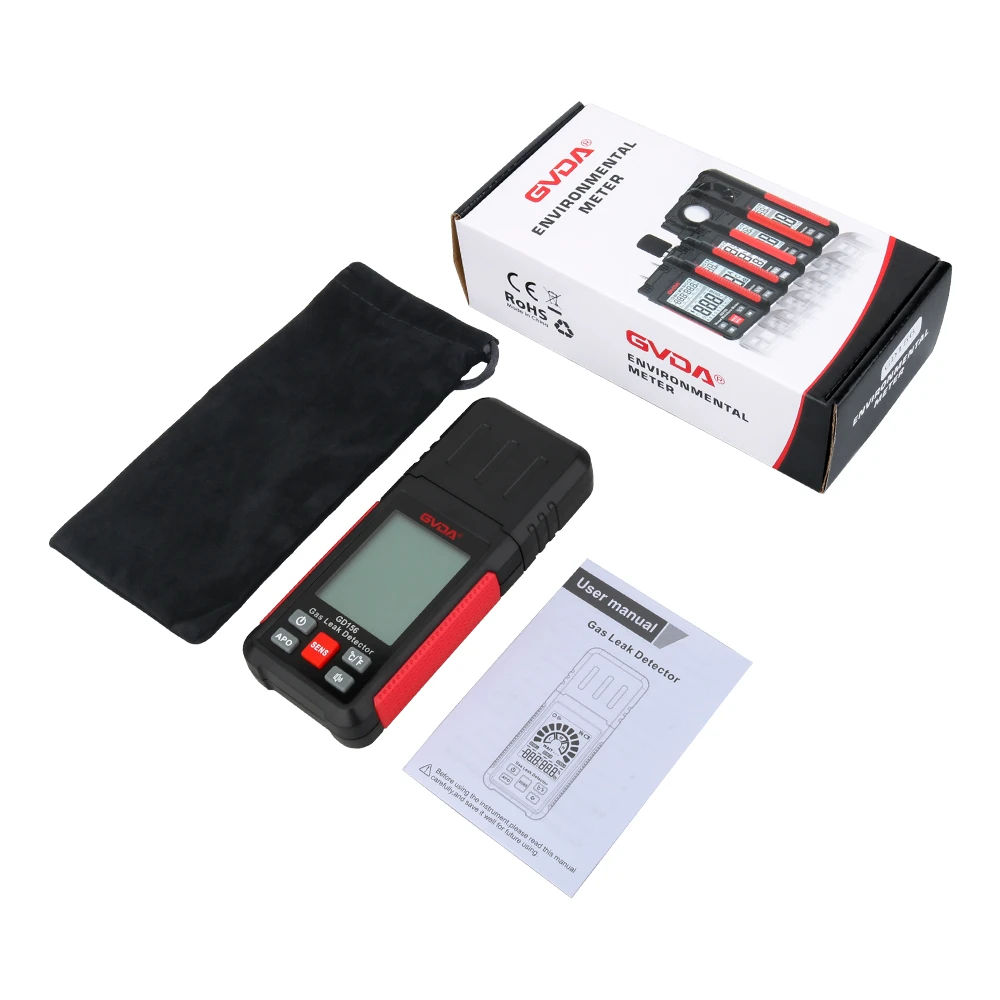
Several Matters Needing Attention for the Operation of Gas Detectors
① Pay attention to regular calibration and detection
Like other analytical and testing instruments, toxic and harmful gas detectors adopt the relative comparison method for measurement. Firstly, the instrument is calibrated with zero gas and standard-concentration gas, and the standard curve is stored in the instrument. During detection, the instrument compares the electric signal generated by the concentration of the gas to be measured with that of the standard gas, so as to calculate the accurate gas concentration value. Therefore, timely zero adjustment and regular calibration are essential to ensure the measurement accuracy of the instrument.
It is worth noting that most current gas detectors support replaceable detection sensors, but this does not mean that different detector probes can be arbitrarily matched to one detector. Whenever replacing the probe, in addition to a certain sensor activation time, the instrument must be recalibrated. In addition, it is recommended to test the instrument response with standard gas before use to ensure that the detector can effectively perform safety protection functions.
② Pay attention to detection interference among different sensors
In general, each sensor corresponds to a specific detected gas, but no gas detector has absolute single-selective detection performance. Therefore, when selecting a gas sensor, it is necessary to fully understand the interference of other gases on the sensor, so as to ensure the accurate detection of the target specific gas.
③ Pay attention to the service life of various sensors
All gas sensors have a certain service life. For portable instruments, LEL sensors have a long service life of about three years; photoionization detectors can be used for four years or longer; electrochemical sensors for specific toxic gases have a relatively shorter service life of 1 to 2 years; oxygen sensors have the shortest service life of approximately one year.
The service life of electrochemical sensors depends on the drying-up of internal electrolyte. Therefore, if the instrument is not used for a long time, sealing and storing it in a low-temperature environment can properly extend its service life. Fixed instruments have a relatively larger volume and accordingly longer sensor service life. Sensors shall be inspected regularly, used within the valid service period, and replaced immediately once they fail.
④ Pay attention to the concentration measurement range of detection instruments
All toxic and harmful gas detectors are equipped with a fixed detection range. Accurate measurement can only be guaranteed when detection is carried out within the rated range. Long-term measurement beyond the detection range will cause permanent damage to the sensor.
For instance, the sensor of an LEL detector may be completely burned if used in an environment exceeding 100% LEL. Similarly, toxic gas detectors will be damaged when operating in high-concentration gas environments for a long time. Therefore, if a fixed detector sends an over-limit alarm signal during operation, the measurement circuit shall be closed immediately to protect the sensor from permanent damage.