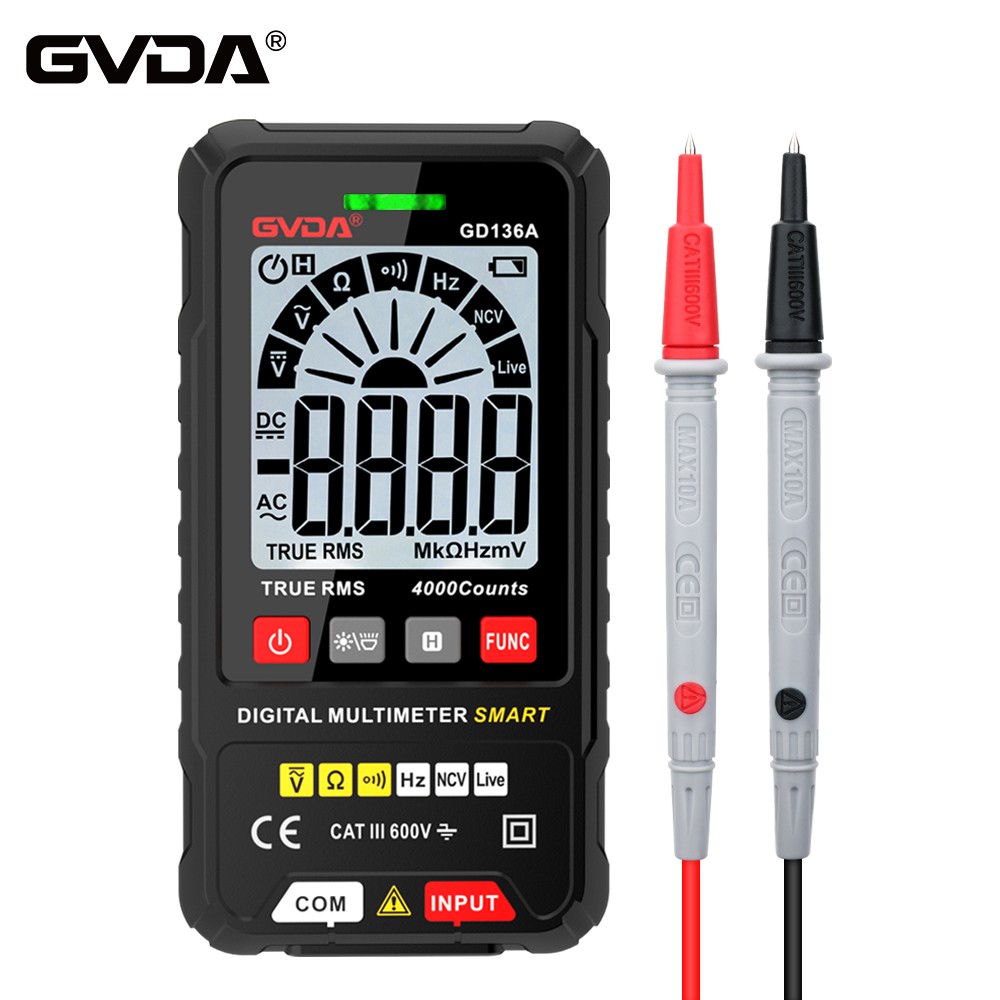
Simple Operation Instructions for Multimeter
Simple operation instructions for multimeter:
1. Voltage below 36V is the safe voltage. When measuring DC and AC voltages above 36V and 25V, it is necessary to check whether the probes are reliably connected, correctly connected, and well insulated to avoid electric shock. 2, When changing functions and ranges, the probe should be away from the testing point, and the correct function and range should be selected during testing to prevent accidental operation.
3, To measure DC voltage, first turn the range switch to the corresponding DCV range, and then connect the test probe across the tested circuit. The voltage and polarity at the point where the red probe is connected are displayed on the screen.
4, For AC voltage measurement, first turn the range switch to the corresponding ACV range, and then connect the test probe across the tested circuit.
5, For direct current measurement, first turn the range switch to the corresponding DCA position, and then connect the instrument in series to the tested circuit.
6, For AC current measurement, first turn the range switch to the corresponding ACA position, and then connect the instrument in series to the tested circuit.
7, Resistance measurement: Turn the range switch to the corresponding resistance range and connect the two probes across the measured resistance.
8, For capacitance measurement, turn the range switch to the corresponding capacitance range, connect the test probe across the measured capacitance and both ends for measurement, and pay attention to polarity if necessary.
9, Pole tube and on-off test, set the range switch to gear. Connect the red probe to the positive terminal of the diode and the black probe to the negative terminal of the diode. When testing the continuity of a circuit, connect the probe to both ends of the circuit to be tested. If the buzzer sounds, the circuit will be turned on, otherwise the circuit will be turned off.
10, Measure the amplification factor of the transistor, set the range switch to the hFE position, and determine whether the transistor being measured is NPN or PNP. Insert the emitter, base, and collector into the corresponding holes. A digital multimeter can be used to measure DC and AC voltage, DC and AC current, resistance, capacitance, inductance, frequency, battery, diode, transistor hFE, and continuity testing. It also has an automatic power-off function. The overall circuit design is based on a large-scale integrated circuit dual integrator A/D converter, and is equipped with a full process overload protection circuit, making it a high-performance tool instrument. It is essential for laboratories, factories, schools, and electronics enthusiasts.