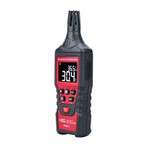
Solutions to inaccurate detection of handheld gas detectors and solutions
solutions:
1. Confirm whether the gas concentration on site is accurate. Sometimes the difference between the theoretical value and the actual value is very large. Verify the accuracy of the instrument by introducing standard gas, or send it to a third-party measurement agency for testing.
2. If the sensor has been used for a long time, there may be some errors in the measured value. You need to confirm with the manufacturer whether the sensor can still be used. If the sensor itself is close to the end of its service life, it can be used normally even after calibration. After a while, it can no longer be used normally. It is recommended to replace the sensor.
When the value is 0 or the alarm value is not reached in the air, it will also alarm
Solution:
1. Check whether the alarm value has been modified.
2. Check the alarm method and whether the alarm mode has been modified.
3. Check whether the alarm state is a concentration alarm or a fault alarm. The words AL or AH will appear on the concentration alarm, and the red indicator light will flash, and the yellow light will be on for the fault alarm.
4. If the alarm caused by artificial modification can be solved by restoring the factory settings, the fault alarm needs to be further checked for short circuit, open circuit, poor contact, sensor failure, etc.
Because the reasons for the contamination of hydraulic oil are relatively complicated, and the hydraulic oil in the hydraulic transmission system is constantly producing pollutants during the working process, it is very difficult to completely prevent pollution.
In order to prolong the service life of hydraulic components and ensure the normal operation of the hydraulic transmission system, the pollution degree of the hydraulic oil should be controlled within a certain range.
Generally, the following measures are taken to control pollution:
1. Eliminate residue pollution: Before and after the hydraulic system is assembled, the parts must be cleaned strictly.
2. Reduce external pollution:
Reduce the pollution sources of the hydraulic system, improve the operating environment of the equipment, strengthen dust control, and reduce the dust on the job site.
The air filter on the fuel tank must be cleaned in time and regularly, the fuel tank must pass through the filter when refueling, and the maintenance and disassembly of components should be carried out in a dust-free area.
3. Filter out the impurities generated by the system: Add appropriate precision filters to relevant parts of the system according to needs, and regularly check, clean or replace the filter elements to maintain the cleanliness of the hydraulic oil.
4. Control the working temperature of hydraulic oil:
The working temperature of the hydraulic oil is 20-60°C. Above 60°C, the life of the hydraulic oil will be reduced by half for every 10°C increase.
According to the actual space position of the equipment, expand the capacity of the fuel tank and ventilate natural cooling to alleviate the rise in oil temperature; in addition, if conditions permit, cooling water can also be added outside the fuel tank.
The water flushing pipeline used by the downhole hydraulic trolley is relatively close to the oil tank, and a branch is connected to cool the oil tank, or double coolers are added to force the hydraulic oil to cool.