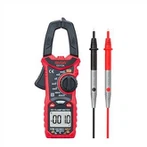
Steps for Testing Capacitor Functionality with a Multimeter
1. To determine polarity, first set the multimeter to 100 or 1K ohms. Assume one pole as the positive pole, connect the black probe to it, and connect the red probe to the other pole. Record the resistance value. Then discharge the capacitor, that is, allow the two poles to touch. After that, swap the probes to measure the resistance. The black probe connected to the higher resistance value is the positive pole of the capacitor.
2. Set the multimeter to an appropriate ohms range. The principle for selecting the range is: use the 20K range for capacitors of 1μF, the 2K range for capacitors between 1-100μF, and the 200 range for capacitors greater than 100μF.
3. Then connect the red probe of the multimeter to the positive terminal of the capacitor and the black probe to the negative terminal. If the display gradually increases from 0 and finally shows the overflow symbol 1, the capacitor is normal. If it always displays 0, the capacitor is internally short-circuited. If it always displays 1, the capacitor is internally open-circuited.
Measuring Capacitance with a Multimeter The capacitance of a capacitor needs to be measured using the capacitance setting of a multimeter. For some capacitors on circuit boards, it is necessary to remove them for measurement, because measuring in-circuit not only measures the capacitance of this capacitor, but also affects other electronic components in parallel or in series within the circuit. Let's look at the specifics.
For example, in a power supply filter circuit, we commonly see an electrolytic capacitor connected in parallel with a 104 chip capacitor. This is because the electrolytic capacitor has a large capacitance and can be used to filter out low-frequency interference signals, while the small chip capacitor is used to filter out some high-frequency interference. If you don't remove them for measurement, the capacitance you actually measure will be the reading produced by the parallel connection of the two capacitors, along with other interferences in the circuit. Therefore, in-circuit measurement is not accurate and requires removal for measurement.
In practical maintenance work, not only capacitors need to be removed for measurement, but also other electronic components such as diodes, resistors, and transistors. In-circuit measurements are affected by the circuit, leading to inaccurate readings. Only by removing them can accurate measurements be taken to determine their condition.