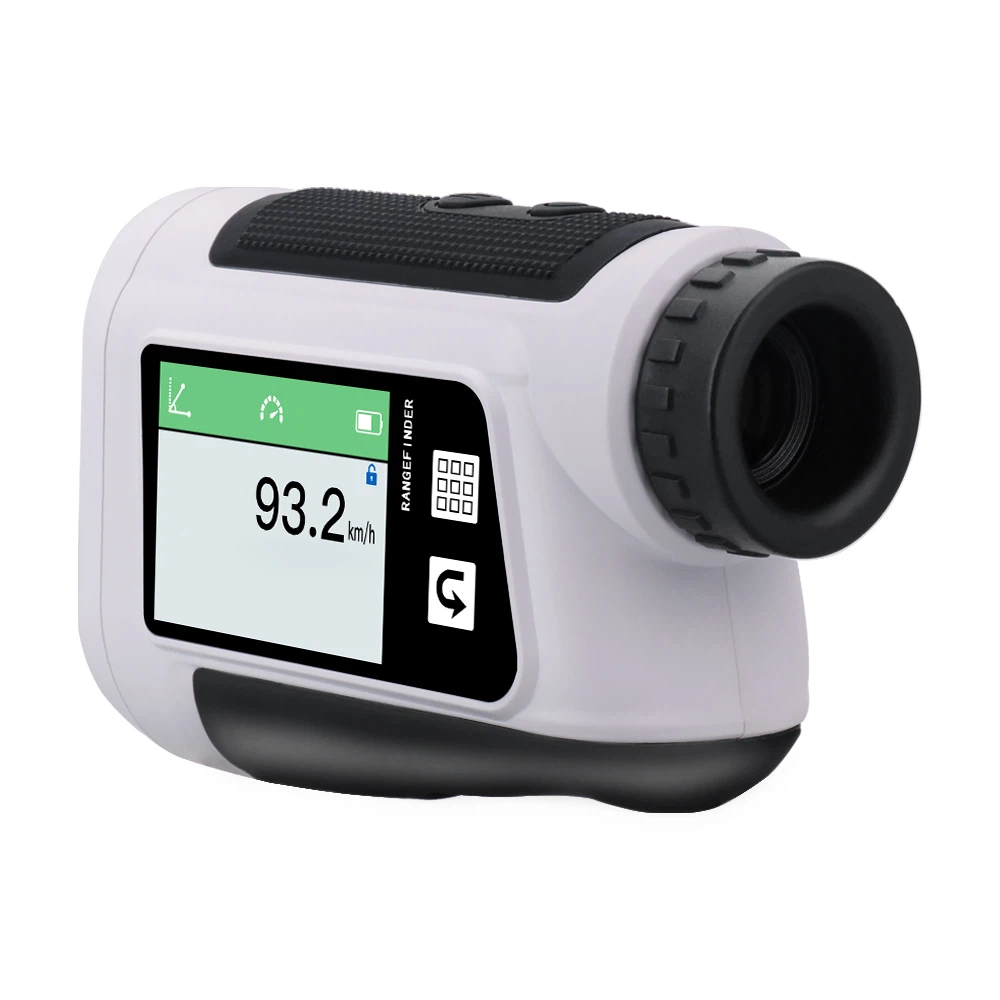
Talking about the principle of laser distance meter
1.Using the principle of infrared ranging or laser ranging
The basic idea behind ranging is to compute the distance D using the speed of light (c = 299792458 m/s) and the atmospheric refraction coefficient (n) after measuring the time needed for the light to travel to and from the target. Since it is challenging to measure time directly, phase-measuring rangefinders are typically used to determine the continuous wave's phase. There are additional pulsed rangefinders, most commonly the WILD DI-3000.
It should be noted that the phase measurement detects the phase of the signal modulated on the infrared or laser, not the phase of the infrared or laser itself. The same type of handheld laser rangefinder is used in the construction sector to measure houses.
2. The plane of the measuring object must be perpendicular to the lightThe rangefinder used for house measurement directly measures by reflection off a smooth wall instead of using a total reflection prism typically because the distance is reasonably close and the signal strength of the reflected light is sufficient. From this, it can be inferred that it must be vertical; otherwise, the return signal would be too weak to determine the specific distance.
3. The plane of the object can be measured as diffuse reflection
It is typically also feasible. A thin plastic plate will be employed as a reflecting surface in practical projects to address the issue of significant diffuse reflection.
4. The accuracy of ultrasonic ranging is relatively low, and the use is relatively small.
5. The accuracy of the laser rangefinder can reach 1 mm error, which is suitable for various high-precision measurement purposes.