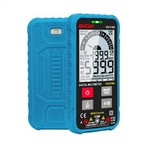
Teach you how to use a multimeter to detect the quality of a single-phase motor, do you know
As a measurement tool, multimeters are widely used in life. In the previous article, I introduced the use of multimeters and several practical applications. Interested friends can pay more attention to them. Today I want to talk to you about how to use a multimeter to measure the quality of single-phase motor windings.
There are many applications of single-phase motors in life, such as electric fans, range hoods, hair dryers, exhaust fans, etc. are single-phase motors. Sometimes these electrical appliances fail, in addition to checking whether the line is damaged, generally speaking, the main thing is to consider the quality of the motor. If you can judge whether the motor is damaged, it will be much easier to repair. If the motor is broken, go to the electronics market to buy a motor and replace it. That is, you have learned the knowledge and saved maintenance costs, so why not do it?
In fact, it is easy to judge the quality of the motor with a multimeter. Now I will tell you how to use a multimeter to judge the quality of the motor.
The internal winding of a single-phase motor is divided into a main winding (running winding) and a secondary winding (starting winding). The main winding of a single-phase motor has a thicker wire diameter, fewer turns and lower resistance; the secondary winding has a finer wire diameter and fewer turns. The larger the number, the larger the resistance. As shown in the figure below: point A is connected to the live wire and capacitor, point B is connected to the neutral wire (common terminal), and point C is connected to the capacitor.
When measuring, turn the multimeter to the resistance gear of 2KΩ (or slightly higher, depending on the motor) or automatic gear. First measure the resistance R1 between 1 and 2; then measure the resistance R2 between 3 and 4; and the resistance R between 2 and 3. After measurement, it must satisfy R=R1+R2. If this formula is true, it means that the internal windings of the motor are in good condition.
After measuring the internal winding of the motor, it is also necessary to measure whether the capacitance and the resistance between the three leads (A, B, C) of the motor and the motor casing are qualified.
When measuring capacitance, turn the multimeter to the capacitance gear. Check whether the measured capacitance is consistent with the capacitance of the capacitor. If it matches, the capacitor is in good condition; otherwise, it is broken.
When measuring the resistance of the three leads of the motor and the motor casing, the resistance gear of the multimeter is also used. Measure the resistance between points A, B, C and the motor case, if the resistance is infinite or greater than 0.5 megohms, it means that the resistance between the motor leads and the motor case is in good condition.
If the above three measurements are OK, it means that the motor is in good condition.