The Circuit Principle of Using Multimeter to Predict the Electric Motor's Steering
Under the condition that the phase sequence of the power supply is known, how should the three lead-out lines of the three-phase asynchronous motor be connected with the power line to ensure that its steering conforms to the regulations. Electric motors, water pump motors, refrigerator motors, etc., especially for large-capacity AC motors, have practical significance.
Use a multimeter to predict the circuit schematic diagram of the motor steering, the operation method is as follows:
For an AC motor that has been in operation, the rotor of the motor generally has residual magnetism. The motor originally has several poles, and the residual magnetism will also have several poles. If the residual magnetic field is used to cut the stator winding, the latter will generate a small induced electromotive force. At this time, the meter can be displayed by a bridged DC mA meter (the DC mA block of a common multimeter).
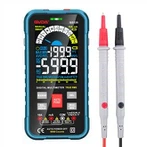
It is assumed that the head and tail of the three-phase stator winding of the motor under test have been sorted out. Use three multimeters of the same model and specifications to wire as shown in the figure. When the motor rotor is turned slowly and evenly by manpower, the motor essentially becomes an ultra-low frequency no-load three-phase generator. At this time, the three-phase induced electromotive force with a difference of 120° electrical angle makes the pointers of the three multimeters swing alternately left and right, but the steps are not consistent. It can be seen that there is a sequence in which the pointer of the multimeter reaches the maximum right deflection each time, and this sequence is the phase sequence of the motor stator winding to be measured. When the phase sequence of the connected power supply is the same as that of the winding phase sequence of the motor, the motor will rotate in the direction of the disk.
How to quickly check the motor control circuit
After the machine tool motor control circuit is connected, it should be checked before power-on test run to prevent wrong connection, missing connection or line failure.
A motor is a device that converts electrical energy into mechanical energy. It uses energized coils (that is, stator windings) to generate a rotating magnetic field and acts on the rotor (such as a squirrel-cage closed aluminum frame) to form a magneto-electric power rotation torque. Motors are divided into DC motors and AC motors according to the power used. Most of the motors in the power system are AC motors, which can be synchronous motors or asynchronous motors (the motor stator magnetic field speed and rotor rotation speed do not maintain synchronous speed). The motor is mainly composed of a stator and a rotor. The direction of the current-carrying wire in the magnetic field is related to the direction of the current and the direction of the magnetic field line (magnetic field direction). The working principle of the motor is that the magnetic field acts on the force of the current to make the motor rotate.