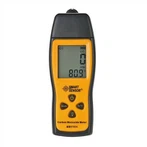
The coating thickness gauge is based on the principle of pulse reflection for thickness measurement
Ultrasonic coating thickness gauge has greatly improved the performance of ordinary thickness gauges in the past, and has measurement stability and repeatability. The magnetic induction intensity is a vector, and the intensity is a physical quantity that characterizes the nature of the magnetic field itself. It has nothing to do with whether the current-carrying conductor is placed in the magnetic field, the angle of the current-carrying conductor placed, or whether the conductor is electrified or not. The principle of magnetic induction is to use the magnetic flux flowing into the iron substrate through the non-ferromagnetic coating to measure the thickness of the coating. The thicker the coating, the smaller the magnetic flux. When the probe with the coil around the soft iron core is placed on the object to be tested, the instrument will automatically output the test current, the magnitude of the magnetic flux will affect the magnitude of the induced electromotive force, and the instrument will amplify the signal to indicate the coating thickness. Widely used in petrochemical, electric power, ship berthing and pipeline, pressure vessel and storage tank wall thickness measurement. It can measure the thickness of metal materials, pipes, pressure vessels, plates (steel plates, aluminum plates), plastics, iron pipes, PVC pipes, glass and other materials.
Ultrasonic coating thickness gauge operating procedures:
1. Preparations
1) The equipment under test should have the conditions for thickness measurement. If it is necessary to enter the internal thickness measurement, it should meet the safety standards before entering.
2) The surface of the thickness measurement part should be cleaned to show cleanness.
3) When entering the interior of the equipment, there should be special personnel to monitor the outside.
2. Thickness measurement operation
1) Install the battery, select the sound velocity for thickness measurement according to the material of the equipment under test, install the probe, and make the thickness gauge in working condition.
2) Thickness measurement shall be carried out according to the parts required by Party A or the third party, and calibration shall be carried out with standard blocks.
3) The coupling agent is glycerin with good sound transmission performance.
4) After the thickness measurement is completed, the battery should be taken out, the probe should be unplugged and wiped clean.
3. Records and reports
1) The measured thickness of the measured parts should be recorded in time, and the coordinates should be used to mark the positions of each measuring point.
2) Level II personnel issue a thickness measurement report in a timely manner. The report should accurately reflect the location and thickness of the thickness measurement points. The thickness measurement report should be reviewed by the responsible inspector and issued by the technical director.
Ultrasonic Coating Thickness Gauge
The ultrasonic coating thickness gauge measures the thickness according to the principle of pulse reflection. When the ultrasonic pulse emitted by the probe passes through the object to be measured and reaches the interface of the material, the pulse is reflected back to the probe. Determine the thickness of the material being measured.