The difference and main application of coating thickness gauge and ultrasonic thickness gauge
Coating thickness gauges and ultrasonic thickness gauges have obvious application fields, both of which are thickness measurements, but coating thickness gauges focus on the measurement of surface coatings, while ultrasonic thickness gauges focus on the basics of wall thickness and plate thickness. material measurements; they both overlap and differ. The user's situation is diverse, and you can choose flexibly according to your own situation!
common ground:
Coating thickness gauges and ultrasonic thickness gauges are both non-destructive testing instruments, that is, instruments that measure the thickness of materials without destroying materials. Both coating thickness gauges and ultrasonic thickness gauges can measure the thickness of materials through probes One-sided contact measurement of material thickness. This avoids the disadvantages of calipers, micrometers, gauges, etc. that need to be stuck from both sides to measure thickness, and takes advantage of non-destructive testing, so it is widely used in plate manufacturing, pipeline anticorrosion, electroplating coating, mechanical parts manufacturing, aerospace and other important field. Coating thickness gauges and ultrasonic thickness gauges are used in the measurement of material thickness in different fields. In fact, the coating thickness gauge focuses on the measurement of the surface coating, while the ultrasonic thickness gauge focuses on the measurement of the base material of the wall thickness and plate thickness.
difference:
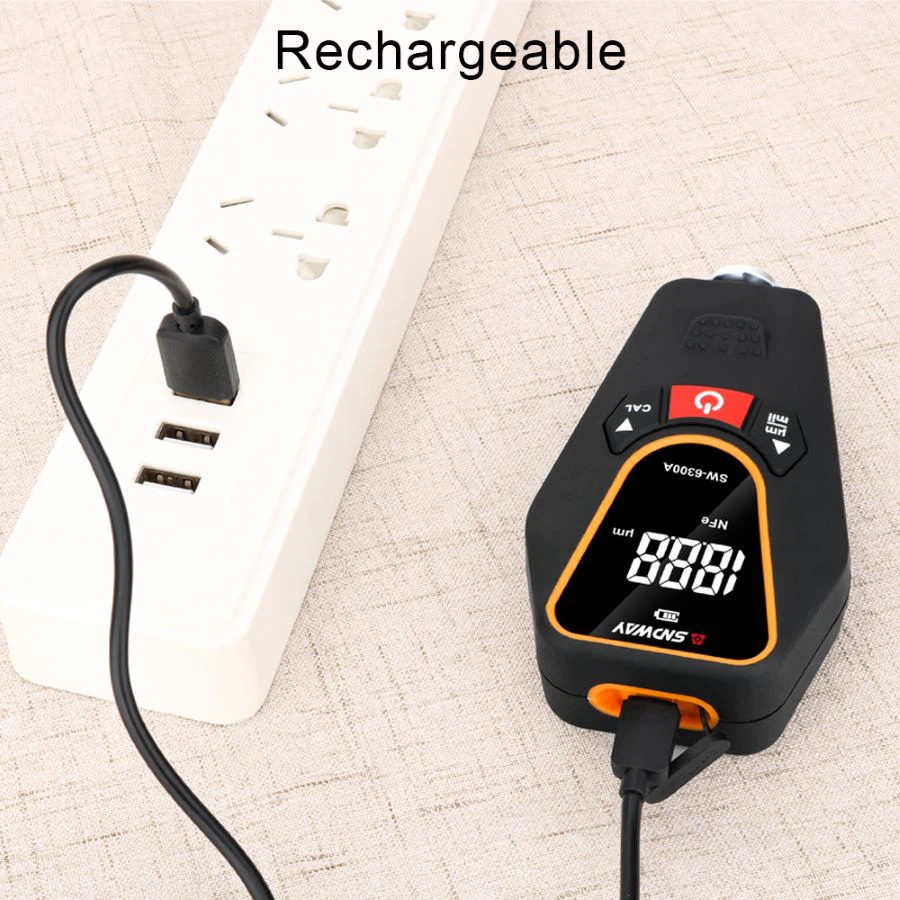
Coating thickness gauge is also called coating thickness gauge, coating thickness gauge, coating thickness gauge, film thickness gauge and other flexible names. It is mainly used to measure coatings, anti-corrosion layers, electroplating layers on metals, The thickness of covering layers such as plastics, paints, plastics, ceramics, enamel, etc., so the official name of the national standard is the cladding thickness gauge. It can also be extended to indirect measurement of the thickness of paper, film, board, etc. The accuracy of the coating thickness gauge is relatively high, generally in the unit of um, and the display resolution can reach 0.01, 0.1, 1um and other accuracy. The measuring range of the coating thickness gauge: generally 0-1250um; special ones are 0-400um and 0-50mm.
There are currently two most mainstream coating thickness gauges: magnetic method and eddy current method, also called: magnetic and non-magnetic method, iron-based and non-ferrous-based method.
Magnetic method: The iron-based coating thickness gauge uses a magnetic sensor to measure non-ferromagnetic coatings and coatings on ferromagnetic metal substrates such as steel and iron, such as: paint, powder, plastic, rubber, synthetic materials, phosphating, Chromium, zinc, lead, aluminum, tin, cadmium, porcelain, enamel, oxide layer, etc.
Eddy current method: Non-ferrous base coating thickness gauge uses eddy current sensors to measure enamel, rubber, paint, plastic layers, coatings, etc. on non-ferrous metal substrates such as copper, aluminum, zinc, and tin. Coating thickness gauges are widely used in manufacturing, metal processing, chemical industry, commodity inspection and other testing fields.