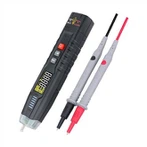
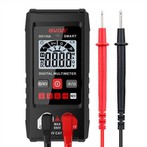
The current transformers of clamp meters can be roughly divided into several categories
Current transformer
When measuring the large current of alternating current, it is necessary to convert it to a relatively uniform current for the convenience of secondary instrument measurement (the secondary rating of current transformers in China is 5A or 1A). In addition, the voltage on the line is relatively high, and direct measurement is very dangerous. The current transformer plays a role in current conversion and electrical isolation. It is a sensor used by secondary equipment such as measuring instruments and relay protection in the power system to obtain electrical primary circuit current information. The current transformer converts high current into low current proportionally. The primary side of the current transformer is connected to the primary system, while the secondary side is connected to measuring instruments and relay protection.
During normal operation, the secondary side of the transformer is in an approximate short-circuit state, and the output voltage is very low. If the secondary winding is open circuit or the primary winding flows abnormal current (such as lightning current, resonant overcurrent, capacitor charging current, inductor starting current, etc.) during operation, overvoltage of thousands of volts or even tens of thousands of volts will be generated on the secondary side. This not only poses a threat to the insulation of the secondary system, but also causes the transformer to become too excited and burn out, even endangering the safety of operators.
Current transformer
The primary side only has one to a few turns, and the wire has a large cross-sectional area, which is connected in series to the tested circuit. The secondary side has multiple turns and thin wires, forming a closed circuit with instruments with lower impedance (current coils of ammeters/power meters).
The operation of a current transformer is equivalent to a transformer with a secondary side short circuit, ignoring the excitation current. The number of ampere turns is equal, I1N1=I2N2
The current ratio between the primary winding current I1 and the secondary winding current I2 of a current transformer is called the actual current ratio I1/I2=N2/N1=k.
Excitation current is the main source of error.
The accuracy level of the current transformer used for measurement is 0.2/0.5/1/3, where 1 indicates that the transformation ratio error does not exceed ± 1%. In addition, there are also 0.2S and 0.5S levels.
2. Protective current transformers
Protective current transformers are divided into: 1. Overload protection current transformers, 2. Differential protection current transformers, 3. Grounding protection current transformers (zero sequence current transformers)
The protective current transformer is mainly used in conjunction with the relay device to provide a signal to cut off the fault circuit to the relay device in case of short circuit overload or other faults in the line, in order to protect the safety of the power supply system. Working conditions and measurement current of protective current transformers
protective current transformer
Transformers are completely different, protective transformers only begin to work effectively when the current is several times or tens of times higher than normal. The main requirements for protective transformers are: 1. Reliable insulation, 2. Sufficient accurate limit coefficient, 3. Sufficient thermal and dynamic stability.