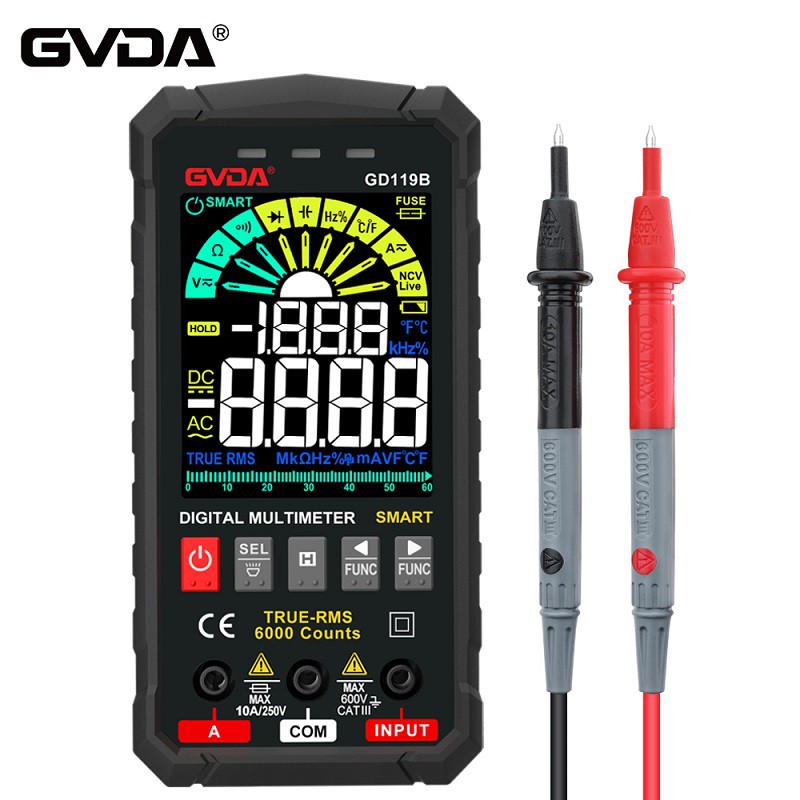
The difference between resolution and resolution of digital multimeter
A multimeter can be called a multimeter. Of course, a digital multimeter can also be called a digital multimeter. Its English name is DMM, and it is also a widely used measuring instrument at present. The digital multimeter can directly display the measured value in digital form. It can not only measure various currents and voltages, but also measure capacitance, resistance, identify various diodes, and test their quality, etc. Next, we mainly introduce the basic functions of the multimeter - the difference between resolution and resolution. Let's learn some knowledge with the editor~
The resolution is the ability of the digital multimeter to distinguish the smallest change in the measured value. It reflects the sensitivity of the meter. On different ranges, the resolution of the meter is different. The meter has the highest resolution on the lowest range, and the highest resolution is defined as the resolution index of the digital multimeter.
Sometimes, the highest resolution is also called the sensitivity of the instrument. The resolution of digital instruments increases with the increase of display digits.
The resolution index can also be expressed by resolution. Resolution refers to the percentage of the smallest number and the largest number that the instrument can display. For example: DT8900 31/2-digit digital multimeter, the smallest number that can be displayed is 1, and the largest number is 1999, so the resolution is equal to 1/1999≈0.05 %.
It should be pointed out that there is a difference between resolution and resolution;
For example, the resolution of 31/2-digit and 33/4-digit instruments is the same, both are 100μV, but the resolutions of the three are different.
Resolution and accuracy belong to two different concepts. The resolution represents the ability of the instrument to "recognize" tiny signals, that is, the "sensitivity", while the accuracy reflects the "accuracy" of the measurement, that is, the measurement result The degree of agreement with the true value. The two are not necessarily related and cannot be confused. In fact, the resolution is only related to the number of display digits of the meter, while the accuracy is related to the comprehensive error and quantization error of the internal A/D converter and functional converter of the meter. In practical applications, the higher the accuracy and sensitivity, the better, but also depends on the specific object to be measured, otherwise it is also a waste.