The Differences and Applications between a Multimeter and an Oscilloscope
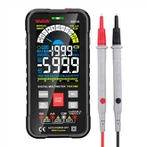
A digital multimeter, as its name implies, is a multifunctional measuring instrument capable of providing measurements of various electrical parameters, including voltage, current, and resistance. Compared with an analog multimeter, a digital multimeter achieves higher measurement accuracy through digital technology and typically features an LCD or LED display to show readings in digital form, making the measurement results more intuitive and precise.
The core advantage of a digital multimeter lies in its ability to accurately measure DC bias. It uses an integrating ADC (Analog-to-Digital Converter), and this conversion method reduces noise and interference by averaging the signal, thereby improving the accuracy of DC measurements. This makes the digital multimeter particularly suitable for accurate measurements of low-frequency or constant signals, such as battery voltage and the DC operating point in a circuit.
The Characteristics and Applications of an Oscilloscope
The original design intention of an oscilloscope is to observe and analyze the changes of a signal over time. It is an instrument capable of displaying the waveform of a voltage changing with time and is commonly used for measuring, monitoring, and debugging electronic circuits. The core function of an oscilloscope is to capture and display the signal waveform, allowing users to clearly see how the signal changes over time, which is particularly important for the analysis of high-frequency signals or complex waveforms.
An oscilloscope usually employs a non-integrating ADC, which means it can measure and reconstruct the signal waveform point by point. This point-by-point measurement method enables the oscilloscope to measure higher-frequency signals and accurately display characteristics such as the shape, amplitude, and period of the signal. In addition, modern oscilloscopes are integrated with various advanced functions, such as Fast Fourier Transform (FFT), waveform storage and playback, and trigger settings, providing users with powerful signal analysis and fault diagnosis capabilities.
Comparison of Application Scenarios
When choosing between a digital multimeter and an oscilloscope, specific testing requirements need to be considered. A digital multimeter is suitable for situations where precise measurement of DC bias, resistance, and low-frequency signals is required. For example, in the maintenance of electronic devices, measuring the power supply voltage or checking whether the soldered joints in the circuit are conducting is very suitable for using a digital multimeter.
On the other hand, an oscilloscope is more suitable for situations where analyzing the signal waveform, measuring high-frequency signals, or observing the changes of the signal over time is required. In the design and development stage of electronic products, an oscilloscope is used to verify the correctness of the circuit design, monitor the integrity of the signal, and debug the timing issues in the digital circuit.