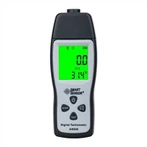
Basic Specifications of Digital Multimeter
Safety
Safety is the primary consideration in the design of digital multimeters. They undergo independent testing by certified laboratories and are marked with logos of testing laboratories such as UL, CSA, and VDE.
Resolution
Resolution, also known as sensitivity, refers to the smallest quantifiable unit of a digital multimeter's measurement result, i.e., the ability to detect tiny changes in the measured signal. For example, if a digital multimeter has a resolution of 1mV in the 4V range, it can detect a 1mV change when measuring a 1V signal. The resolution of a digital multimeter is generally expressed in digits or words.
Resolution is a critical indicator. Just as you would not use a ruler with a minimum unit of centimeters to measure a length smaller than 1 millimeter, or use a thermometer with only integer markings to measure a temperature of 98.6°F (you would need a thermometer with a resolution of 0.1°F), high resolution is essential for precise measurements.
Accuracy
Accuracy refers to the maximum allowable error under specific usage conditions. In other words, it indicates how close the multimeter's measured value is to the actual value of the tested signal. For digital multimeters, accuracy is typically expressed as a percentage of the reading. For example, a reading accuracy of 1% means that when the multimeter displays 100.0V, the actual voltage may range between 99.0V and 101.0V.
Detailed specifications may include a specific value added to the basic accuracy, which refers to the number of digits to adjust for the rightmost digit of the display. In the previous example, the accuracy might be stated as ±(1% + 2). Thus, if the multimeter reads 100.0V, the actual voltage will be between 98.8V and 101.2V.
The accuracy of analog meters (or pointer multimeters) is calculated based on the error of the full measurement range, not the displayed reading. The typical accuracy of pointer multimeters is ±2% or ±3% of the full scale. The typical basic accuracy of digital multimeters ranges between ±(0.7% + 1) and ±(0.1% + 1), or even higher.