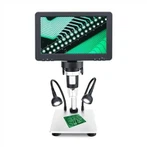
The evolution and application of metallographic microscopes
The imaging principle of a telescope is similar to that of a microscope. While studying telescopes, Galileo of Italy and Kepler of Germany changed the distance between the objective lens and the eyepiece to arrive at a reasonable optical path structure for the microscope. The optical craftsmen at that time then They have been engaged in the manufacture, promotion and improvement of microscopes. Due to the rapid development of the mining industry, microscopic observation of the internal structure of metals is required, and the metallographic microscope officially debuted, which initially laid the basic structural framework of the metallographic microscope.
Around 1665, Hooke added coarse and fine focusing mechanisms, an illumination system, and a worktable for carrying specimens to the microscope. After continuous improvement, these components not only make the imaging of metallographic microscopes clearer, faster and easier to carry, but also become a basic component of modern metallographic microscopes.
In the 19th century, the emergence of high-quality achromatic immersion objectives greatly improved the ability of metallographic microscopes to observe fine structures. This also promotes the advancement of metallographic microscopes into medical and biological research. In 1827, Amici was the first to use a liquid immersion objective lens, which extended the service life of the objective lens and ensured imaging quality. In the 1870s, the German Abbe (founder of Zeiss) laid the classical theoretical foundation for microscope imaging and particle microscopy. These have promoted the rapid development of metallographic microscope manufacturing and microscopic observation technology.
While the structure of the microscope itself is developing, microscopic observation technology is also constantly innovating: polarized light microscopy appeared in 1850; interference microscope appeared in 1893, which is now the micromolecular interference microscope; in 1935, Zeiss engineers and physicists Zelnick invented phase contrast microscopy, for which he won the Nobel Prize in Physics in 1953. The classical optical microscope is just a combination of optical components and precision mechanical components. It uses the human eye as a receiver to observe the magnified image. Later, a photographic device was added to the microscope, and photosensitive film was used as a receiver that could be recorded and stored. Thus, the video microscope was born. In modern times, optoelectronic components, television camera tubes, and charge couplers are commonly used as receivers of microscopes, and coupled with microelectronic computers, they form a complete image information collection and processing system.
With the continuous development of technology and the continuous improvement of equipment, today's metallographic microscopes have further developed in terms of imaging and light sources than early microscopes. Early microscopes focused primarily on the correction of chromatic aberration and partial spherical aberration, with achromatic and apochromatic objectives depending on the degree of correction. In recent metallographic microscopes, sufficient attention has been paid to aberrations such as object field curvature and distortion. After the objective lens and eyepiece are corrected for these aberrations, not only the image is clear, but also its flatness can be maintained over a large range, which is particularly important for metallographic microphotography. Therefore, plan achromatic objectives, plan apochromatic objectives, and wide-field eyepieces are now widely used. In addition, the earliest metallographic microscopes used ordinary incandescent bulbs for illumination. Later, in order to improve the brightness and lighting effect, low-voltage tungsten lamps, carbon arc lamps, xenon lamps, halogen lamps, mercury lamps, etc. appeared. Some special performance microscopes require monochromatic light sources, sodium lamps.
Metallurgical microscopes can now be widely used in medical and health institutions, laboratories, research institutes, and colleges and universities for biology, pathology, bacteriology observation, teaching and research, clinical experiments, and routine medical inspections; for materials inspection in factories and laboratories Analysis and Identification. The metallographic microscope is mainly used to identify and analyze the internal structure of metals. It is an important instrument for studying metallography and a key equipment for the industrial sector to identify product quality. The instrument is equipped with a camera device that can capture metallographic images and analyze Perform measurement and analysis on the graph, and perform functions such as editing, output, storage, and management of images. Because of its easy operation, large field of view, and relatively low price, metallographic microscopes are still the most commonly used instruments in routine inspection and research work.