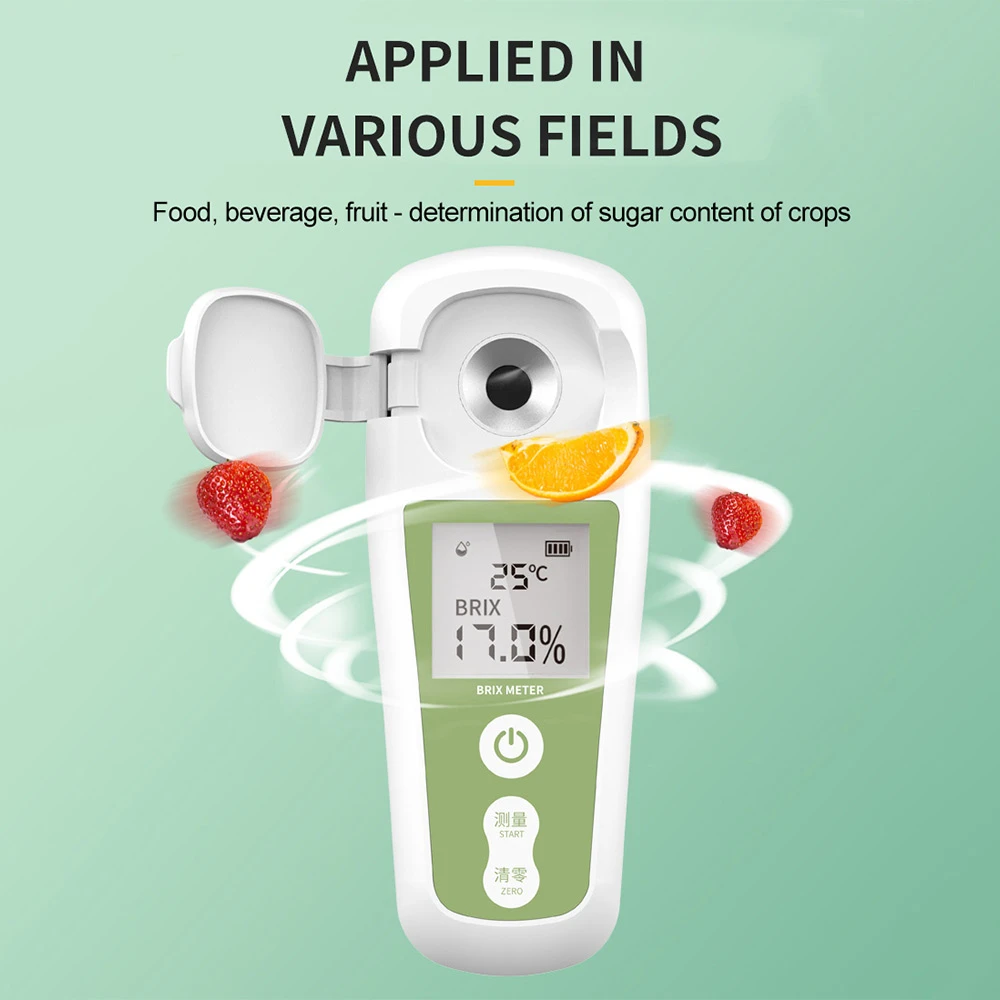
The principle of a sugar meter and how to use it
1, Digital sugar meter:
The digital sugar meter is used for convenient and rapid determination of weight percentage concentration or refractive index in sugar containing solutions. Widely used in industrial sectors such as sugar production, food, beverages, as well as in agricultural production and scientific research.
Working principle: The sugar meter mainly utilizes the phenomenon of refraction when light enters another medium from one medium, and the ratio of the incident angle sine is constant, which is called the refractive index. The refractive index of a sugar solution can be determined by taking advantage of the direct ratio between the content of soluble substances in the sugar solution and the refractive index in a normal environment. This allows the sugar meter/refractometer to calculate the concentration of sugar.
2, Handheld refractometer
A handheld refractometer is an instrument that can measure the refractive index nD and average dispersion nF nC of transparent, semi transparent liquids or solids (with a focus on measuring transparent liquids). If a thermostat is connected to the instrument, the refractive index ND can be measured within a temperature range of 0-70. The refractive index and average dispersion are important optical constants of a substance, which can be used to understand its optical properties, purity, concentration, and dispersion size. Due to its ability to measure the percentage of sugar concentration in sucrose solution, handheld refractometers have a wide range of applications and are essential equipment for factories, schools, and research units in the petroleum industry, oil and fat industry, paint industry, food industry, daily chemical industry, sugar industry, and geological exploration.