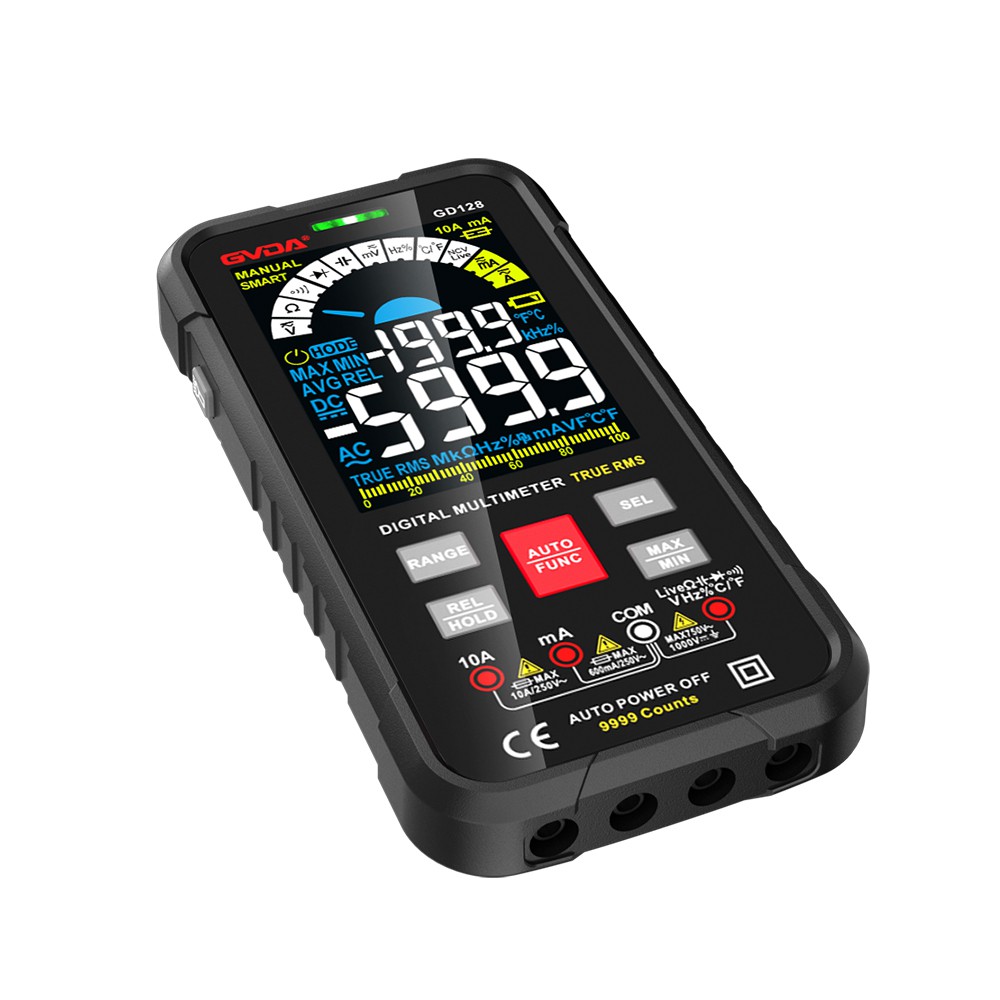
The reasons for the LED light bead not lighting up as measured by a multimeter
Characteristics of Diodes
Diodes have the characteristic of conducting in the forward direction and blocking in the reverse direction. That is, they only allow current to flow from one end of the diode to the other. If the direction is reversed, the current will be blocked and unable to pass through. For a diode to achieve forward conduction and reverse blocking, it must meet one condition - the applied voltage in the forward direction is greater than the conduction voltage.
As shown in the figure above, assume that the forward conduction voltage of this diode is 2V. When the voltage at terminal a is 2V higher than the voltage at terminal b, the diode conducts, and the current flows from terminal a to terminal b. If the voltage is less than 2V, the current cannot pass through.
How to understand this?
We can regard the diode as an iron door. The iron door only allows it to be pushed open from the outside to the inside, and it cannot be pushed open from the inside to the outside. This is similar to the unidirectional conduction characteristic of the diode.
Similarly, because this iron door is relatively heavy, although it can be pushed open from the outside to the inside, a certain amount of force needs to be applied. This is similar to the conduction voltage of the diode.
Measuring Light-Emitting Diodes (LEDs) with a Multimeter
There is a diode range in the multimeter, which is generally integrated with the continuity buzzer range. The no-load voltage of the diode range of a digital multimeter (that is, the voltage between the two test leads when no resistor is connected to the multimeter) is very low, generally around 3V, and there may be some differences among different multimeters.
The conduction voltages of LEDs of different colors and models are different. Generally, the voltage drops of red, yellow, and orange LEDs are about 1.8 - 2.2V. The voltage drops of white, green, blue, and pink LEDs are about 2.7 - 3.3V. The voltage of the LED lamp beads used at home is generally around 3V.
Conclusion
Since the conduction voltages of different LEDs are different and this parameter has a large range, it is normal that an LED lamp bead does not light up when measured with a multimeter. Even when using the same multimeter to measure LEDs of different colors, their brightness is different. Generally, the red LED is the brightest, the blue LED is the darkest, and the purple LED may not even light up.
From this, it can be known that when an LED lamp bead does not light up during measurement with a multimeter, a possible reason is that the positive and negative poles of the test leads and the diode are connected in reverse.
For an analog multimeter, the black test lead should be connected to the positive pole of the diode, and the red test lead should be connected to the negative pole of the diode. For a digital multimeter, the red test lead should be connected to the positive pole of the diode, and the black test lead should be connected to the negative pole of the diode.