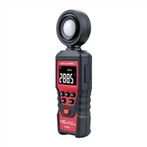
The selection, use, and technical exchange of clamp ammeters
A clamp type ammeter is a combination of a current transformer and an ammeter. The iron core of the current transformer can be opened when the wrench is tightened; The wire through which the measured current passes can pass through the open gap of the iron core without cutting it off. When the wrench is released, the iron core closes.
Selection method of clamp ammeter
(1) Firstly, it should be clear whether the measured current is AC or DC. The rectifier clamp type ammeter is only suitable for measuring power frequency currents with low waveform distortion and little frequency change, otherwise it will result in significant measurement errors. For electromagnetic clamp ammeters, the deflection property of the movable part of the measuring mechanism is independent of the polarity of the current. Therefore, it can be used to measure both AC current and DC current, but the accuracy is usually relatively low. The accuracy of clamp type ammeters mainly includes levels 2.5, 3, and 5, and should be selected based on measurement technical requirements and actual situations.
(2) For digital clamp ammeters, the reading of their measurement results is intuitive and convenient, and the measurement functions have also been expanded to measure parameters such as resistance, diode, voltage, active power, reactive power, power factor, frequency, etc. However, digital clamp ammeters are not perfect. When electromagnetic interference in measurement situations is severe, the displayed measurement results may experience discrete jumps, making it difficult to confirm the actual current value; If a pointer type clamp type ammeter is used, due to the damping effect of the magnetoelectric mechanical meter head itself, its response to strong electromagnetic field interference is relatively slow. At best, the meter needle produces a small amplitude of oscillation, and its reading range is relatively intuitive, making it relatively easy to read.
Preparation before using the ammeter:
1. Zero calibration, use a flat screwdriver to adjust the zero calibration button.
2. Choose a range {estimated using experience or using trial contact method}.
Rules for using ammeters:
1. The ammeter should be connected in series in the circuit (otherwise it will short-circuit)
2. The current should enter from the "+" terminal and exit from the "-" terminal (otherwise the pointer will reverse)
3. The measured current should not exceed the range of the ammeter (trial contact method can be used to see if it exceeds the range)
4. It is absolutely not allowed to connect the ammeter to the two poles of the power supply without passing through the electrical appliance (the internal resistance of the ammeter is very small, equivalent to a wire. If the ammeter is connected to the two poles of the power supply, it may cause the pointer to tilt, and in severe cases, it may burn the ammeter, power supply, and wire.)