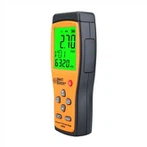
The simple principle of measuring coating thickness with a coating thickness gauge
We all know that the purpose of coating thickness gauges is mainly to measure the thickness of surface coatings on objects, including measuring the thickness of coatings. So how does a coating thickness gauge achieve the testing of coating thickness? The professionals from Yigao Coating Thickness Gauge introduced to us that coating thickness gauges mainly measure coating thickness through electromagnetic induction.
The so-called coating thickness actually refers to the direct distance between the measuring probe of the coating thickness gauge and the ferromagnetic material. The surface of the coating thickness gauge has a probe, and the probe has a closed magnetic circuit inside. When the direct distance between the magnetic iron material product and the probe changes, the closed circuit also changes. This change will drive changes in the inductance and magnetic resistance of the probe coil, thereby measuring the coating thickness.
Classification and division of coating thickness gauges
The coating thickness gauge is mainly used as a specialized instrument to detect the thickness of coatings on workpieces. There are many types of thickness gauges, and Qingrui Company's is mainly used for detecting the thickness of coatings or coatings on metals.
Coating thickness testing instruments are divided into magnetic thickness gauges and non-magnetic thickness gauges (i.e. eddy current coating thickness gauges) based on their measurement principles.
Classification of coating thickness gauge models:
Generally, it can be divided into split machine and integrated machine. Split machine refers to a probe that is connected to the host through a probe wire, and the integrated machine probe is built-in.
The magnetic coating thickness gauge is mainly used to detect the thickness of the coating layer through the magnetic thickness measurement method. The magnetic thickness measurement method can be used to measure the thickness of all non magnetic metals and non-conductive layers on iron and steel magnetic metals, such as copper, zinc, chromium, gold, silver, etc. coated on iron, paint, plastic, rubber, phosphating film, fiberglass, etc.
The eddy current layer thickness gauge can measure the thickness of non-conductive coatings on non magnetic conductive metals, such as paint layers, oxide films, phosphating films, fiberglass, rubber, and other coatings on stainless steel, copper, and aluminum metals.
Some customers require anti-corrosion treatment inside the pipeline, and in this case, specific internal anti-corrosion probes can be customized to measure the coating thickness inside the pipeline. Requirement: For pipes with an inner diameter of over 35mm.