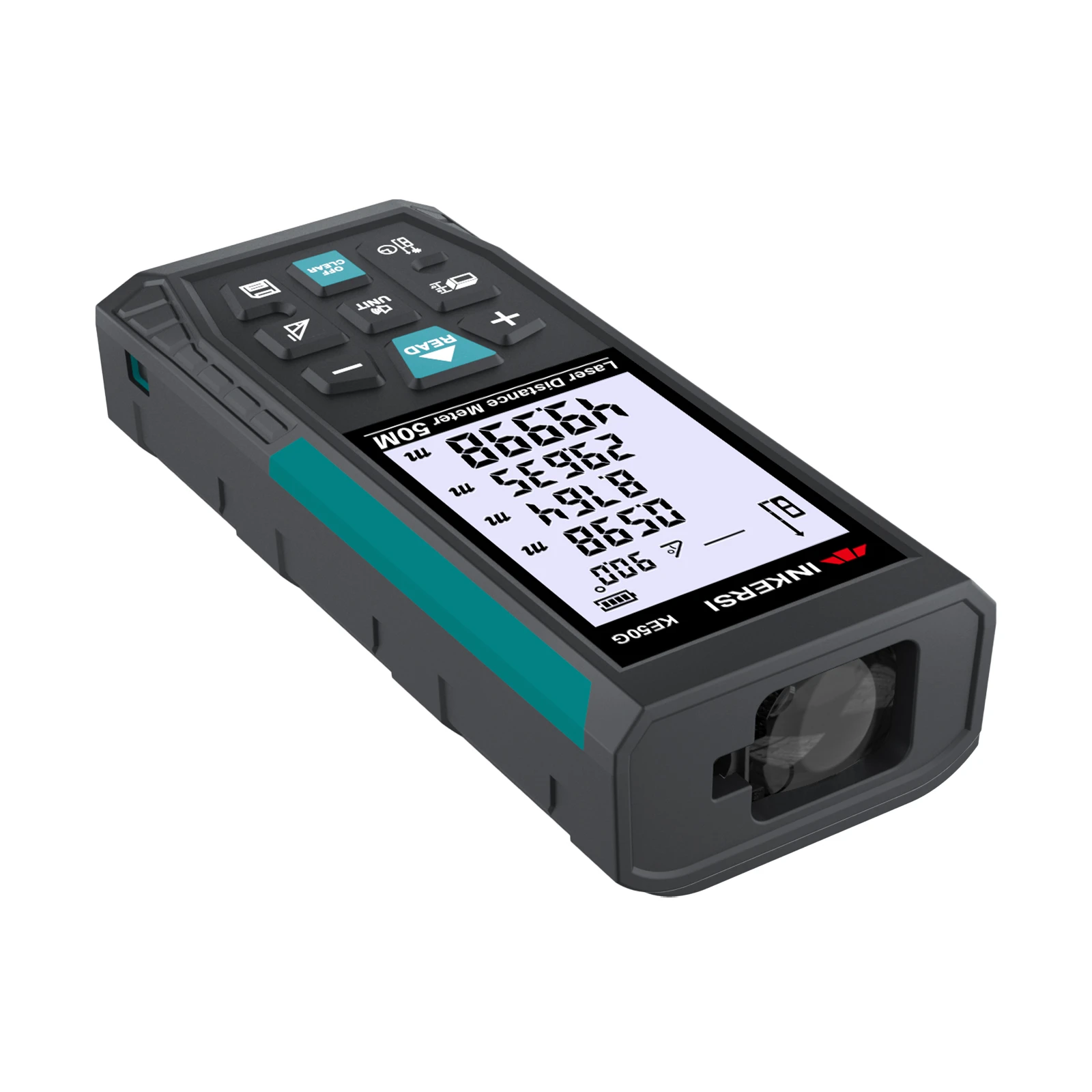
The structural composition of infrared rangefinder
The infrared rangefinder mainly consists of a modulation light emission unit, a receiving unit, a phase measurement unit, a counting display unit, a logic control unit, and a power converter. Its light source is usually an arsenide (GaAs) semiconductor light-emitting diode. When a considerable amount of current passes forward through the P-N junction of GaAs diodes, a wavelength of 0.72 will be emitted from the P-N junction μ m. 0.94 μ The near-infrared light of m is generated due to the excess energy released in the form of photons during electron hole recombination in doped GaAs semiconductors. And the emitted light intensity will vary with the change of injection current. Therefore, by using it as the light source of the rangefinder, the emitted light intensity can be directly modulated by changing the magnitude of the feeding current. This semiconductor light-emitting device has both "radiation" and "modulation" dual functions.
The infrared photodetector converter devices used for receiving modulated light are usually silicon photodiodes or avalanche photodiodes, which have a "photovoltage effect". When external light shines on its P-N junction, a potential difference can be generated at the P-N poles due to the effect of photoelectric energy conversion, and its magnitude will vary with the input
The intensity of the emitted light varies, thus playing a role in de modulation.
Introduction to the uses of ultrasonic rangefinders
Ultrasonic waves propagate at different speeds in gases, liquids, and solids, with good directionality, concentrated energy, minimal attenuation during transmission, and strong reflection ability. Ultrasonic waves can propagate at a certain speed and form reflections when encountering obstacles. By using this characteristic, the actual distance can be calculated by measuring the time it takes for ultrasonic waves to travel back and forth, thus achieving non-contact distance measurement of objects. Ultrasonic ranging is fast, convenient, and not affected by factors such as light. It is widely used in fields such as hydrological level measurement, construction site measurement, on-site position monitoring, detection of obstacles in the back of vibrating vehicles, and detection and positioning of mobile machines. The digital ultrasonic rangefinder designed in this article counts the clock pulses input to a specific frequency of the counter during the ultrasonic round-trip time, and displays the corresponding measurement distance.