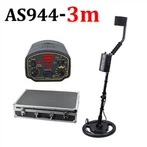
The structure of each component of anemometer
The anemometer is based on the cold shock airflow carrying away the heat from the heating element. With the help of a regulating switch, the temperature is kept constant, and the regulating current is proportional to the flow rate. When using a thermal sensitive probe in turbulence, airflow from all directions simultaneously impacts the thermal element, which can affect the accuracy of the measurement results. When measuring in turbulence, the reading of the thermal anemometer flow sensor is often higher than that of the rotary probe. The above phenomenon can be observed during pipeline measurement. According to different designs for managing turbulent flow in pipelines, it may even occur at low speeds.
Therefore, the anemometer measurement process should be carried out in the straight section of the pipeline. The starting point of the straight section should be at least 10 × D (D=pipe diameter, in CM) outside the measurement point; The endpoint should be at least 4 × D behind the measurement point. The fluid cross-section must not have any obstruction
Wheel type probe of anemometer
The working principle of the anemometer's rotary probe is based on converting rotation into electrical signals. First, it passes through a proximity sensing head to "count" the rotation of the rotor and generate a pulse series. Then, it is converted and processed by the detector to obtain the speed value.
The large-diameter probe (60mm, 100mm) of the anemometer is suitable for measuring turbulent flow with medium to low velocities (such as at pipeline outlets). The small-diameter probe of the anemometer is more suitable for measuring airflow in pipelines with a cross-sectional area greater than 100 times that of the exploration head.
The correct adjustment position of the anemometer's rotary probe in the airflow is that the airflow direction is parallel to the rotary axis. When the probe is gently rotated in the airflow, the reading will change accordingly. When the reading reaches the maximum value, it indicates that the probe is in the correct measurement position. When measuring in a pipeline, the distance from the starting point of the straight part of the pipeline to the measurement point should be greater than 0XD. Turbulence has a relatively small impact on the thermal sensitive probe and pitot tube of the anemometer.
Practice has shown that the 16mm probe of an anemometer is the most widely used for measuring airflow velocity inside pipelines. Its size ensures good permeability and can withstand flow velocities up to 60m/s. The measurement of airflow velocity inside pipelines is one of the feasible measurement methods, and the indirect measurement protocol (grid measurement method) is applicable to air measurement.