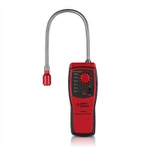
Thermal anemometer: heating and ventilation system measurement application
With the improvement of living standards, many places have adopted heating and air conditioning systems, and the installation technology of heating and air conditioning systems directly affects people's health. The airflow changes at air conditioning vents, HVAC exhaust vents, and exhaust vents directly affect human comfort. Installation personnel usually use anemometers to measure air flow rate, velocity, and temperature in response to changes in airflow. Among them, the most widely used anemometer is the thermal anemometer.
The impeller anemometer can be divided into constant current anemometer and constant temperature anemometer. Constant temperature anemometer has small thermal hysteresis effect, wide frequency response, and fast response, while constant current anemometer does not have the above characteristics** The main purposes of an anemometer are: to measure the average flow velocity and direction, to measure the pulsating velocity and its spectrum of the incoming flow, to measure the Reynolds stress in turbulence and the velocity and time correlation between two points, to measure wall shear stress, to measure fluid temperature, etc. It is one of the highly sensitive anemometers.
The temperature of the air supply in the heating system directly affects the comfort level of the human body; What is the required air flow rate and speed for the ventilation outlet to maintain a fresh indoor air? These problems can be solved by using a thermal anemometer for measurement. This anemometer is a stable and reliable professional anemometer that can measure wind speed, air volume, air temperature, etc. It has high accuracy, small error, portable design, and is easy to carry to various work points for measurement.
With USB interface, maximum and minimum average values, and data retention function, this thermal anemometer can input data into a computer and display multiple analysis values for more convenient data analysis by users. In addition, the range of the anemometer is 0.2-20m/s, equipped with a thermal sensitive wind speed retractable probe, which can easily handle even small space measurements. For measuring the air volume inside the pipeline, this anemometer can be used to automatically calculate the air volume by inputting the cross-sectional area of the pipeline.
With a large backlit LCD display, this thermal anemometer can operate smoothly even in dark environments and read measurement values clearly. Thermal anemometers can be widely used in monitoring indoor air quality and industrial health environment engineering, environmental testing inside pipelines, performance debugging of HVAC equipment, and other fields.