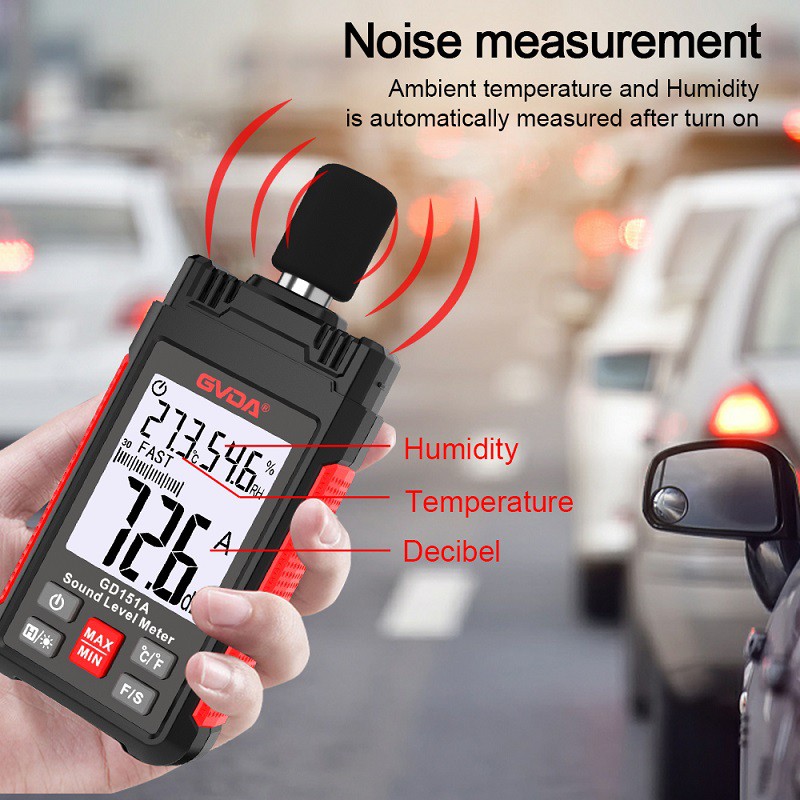
The structure of the sound level meter
The sound level meter is the most basic noise measuring instrument. It is an electronic instrument, but it is different from objective electronic instruments such as voltmeters. When converting an acoustic signal into an electrical signal, it can simulate the time characteristics of the human ear's response speed to sound waves; the frequency characteristics of different sensitivities to high and low frequencies and the intensity characteristics of changing the frequency characteristics at different loudness. The sound level meter is a subjective electronic instrument
The structure of the sound level meter
It is composed of microphone, amplifier, attenuator, weighting network, detector, indicating meter and power supply.
1. Microphone
It is a device that converts a sound pressure signal into a voltage signal, also known as a microphone, and is an excellent sensor. Common microphones are crystal, electret, moving coil, and condenser.
The moving coil sensor consists of a vibrating diaphragm, a moving coil, a permanent magnet and a transformer. The vibrating diaphragm starts to vibrate after being subjected to sound wave pressure, and drives the movable coil installed with it to vibrate in the magnetic field to generate an induced current. The current varies according to the magnitude of the acoustic pressure on the vibrating diaphragm. The greater the sound pressure, the greater the current generated; the smaller the sound pressure, the smaller the current generated.
Capacitive sensors are mainly composed of metal diaphragms and metal electrodes that are close together, which is essentially a flat plate capacitor. The metal diaphragm and metal electrodes constitute the two plates of the flat capacitor. When the diaphragm is subjected to sound pressure, the diaphragm deforms, the distance between the two plates changes, and the capacitance also changes, thereby generating an alternating voltage whose waveform is within the linear range of the microphone and the sound pressure level Forming a ratio realizes the function of converting the sound pressure signal into a voltage signal.
Condenser microphone is an ideal microphone in acoustic measurement. It has the advantages of large dynamic range, flat frequency response, high sensitivity and good stability in general measurement environment, so it is widely used. Since the output impedance of the capacitive sensor is very high, it is necessary to perform impedance transformation through the preamplifier. The preamplifier is installed inside the sound level meter close to the part where the capacitive sensor is installed.
2. Amplifier and attenuator
Many domestic and imported amplifiers that are popular at present use two-stage amplifiers in the amplification circuit, namely, the input amplifier and the output amplifier, and their function is to amplify weak electrical signals. The input attenuator and the output attenuator are used to change the attenuation of the input signal and the attenuation of the output signal, so that the pointer of the gauge head points to the appropriate position, and the attenuation of each gear is 10 decibels. The adjustment range of the attenuator used by the input amplifier is the bottom end of the measurement (such as 0~70 dB), and the adjustment range of the attenuator used by the output amplifier is the high end of the measurement (70~120 dB). The dials of the input and output attenuators are often made of different colors, and currently black and transparent are often paired. Since the high and low of many sound level meters are limited by 70 decibels, it is necessary to prevent the limit from being exceeded when rotating, so as not to damage the device.
3. Weighting network
In order to simulate the different sensitivities of human hearing at different frequencies, there is a built-in one that can simulate the auditory characteristics of the human ear and correct the electrical signal to a network that is similar to the hearing. This network is called a weighting network. The sound pressure level measured through the weighting network is no longer the sound pressure level of the objective physical quantity (called linear sound pressure level), but the sound pressure level corrected by the sense of hearing, called the weighted sound level or noise level.
There are generally three types of weighting networks: A, B, and C. The A-weighted sound level is to simulate the frequency characteristics of the human ear to low-intensity noise below 55 decibels; the B-weighted sound level is to simulate the frequency characteristics of 55-85 decibels of moderate-intensity noise; the C-weighted sound level is to simulate the frequency characteristics of high-intensity noise characteristic. The difference between the three is the degree of attenuation of the low-frequency components of the noise. A attenuates the most, followed by B, and C the least. A-weighted sound level is the most widely used noise measurement in the world because its characteristic curve is close to the hearing characteristics of the human ear, and B and C are gradually used. Noise level readings taken from sound level meters must indicate the conditions of measurement.
4. Geophone and indicator head
In order to display the amplified signal through the meter, a detector is also required to convert the rapidly changing voltage signal into a slower changing DC voltage signal. The magnitude of this DC voltage is proportional to the magnitude of the input signal. According to the needs of measurement, the detector can be divided into peak detector, average detector and black RMS detector. The peak detector can give the maximum value of a certain time interval, and the average detector can measure its absolute average value in a certain time interval. Root-square detectors are used in most measurements, except for impulsive sounds such as gunfire, which require peak measurements.
The root mean square value detector can square, average and square root the AC signal to obtain the root mean square value of the voltage, and finally send the root mean square voltage signal to the indicator head. The indicating meter head is an electric meter, as long as its scale is calibrated, the decibel value of the noise level can be read directly from the meter head. . The average time of the "fast" gear is 0.27s, which is very close to the physiological average time of the human auditory organ; the average time of the "slow" gear is 1.05s. When measuring steady-state noise or needing to record the sound level change process, it is more appropriate to use the "fast" gear; when the fluctuation of the measured noise is relatively large, it is more appropriate to use the "slow" gear.