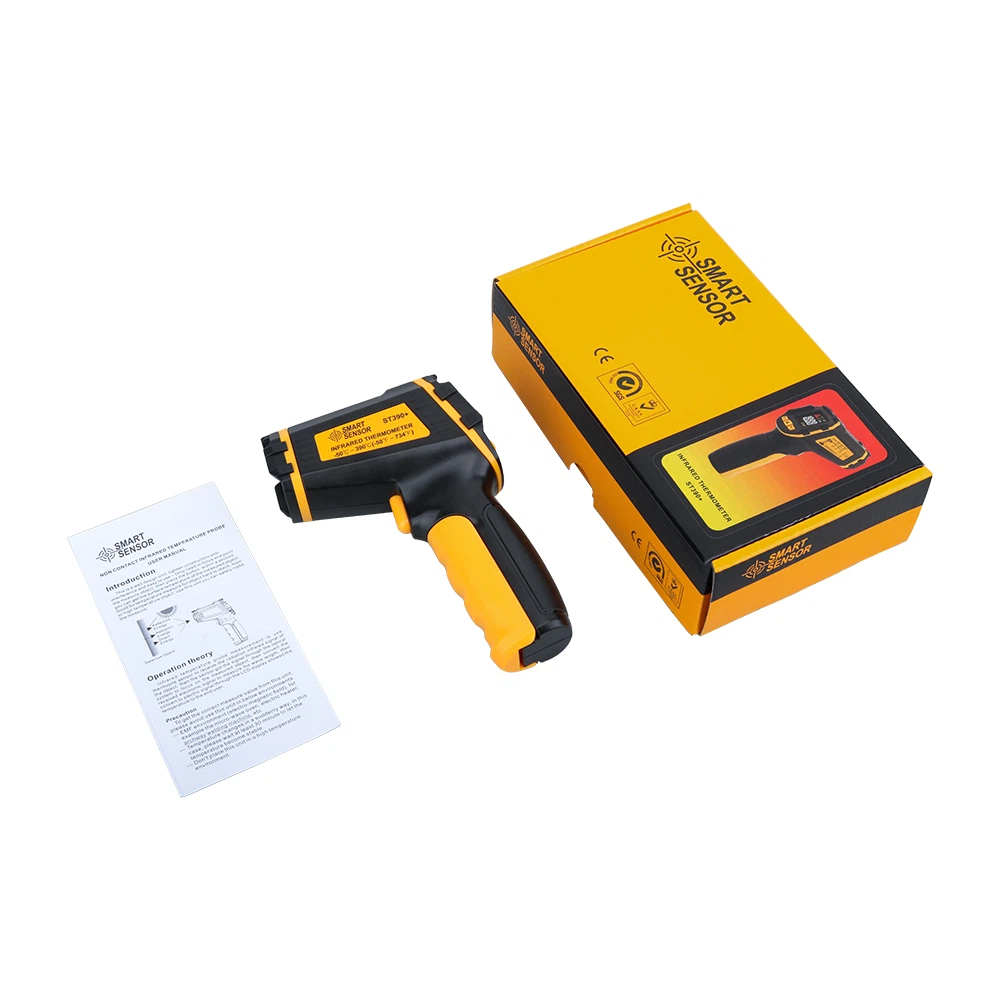
The Technical Features and Usage Methods of Infrared Thermometers
Infrared temperature measurement technology plays a vital role in production processes, including product quality control and monitoring, on-line equipment fault diagnosis, safety protection, and energy conservation. Over the past two decades, non-contact infrared thermometers have achieved rapid technological advancement, with continuously optimized performance, expanded functions, diversified product types, wider application ranges, and rising market share year by year.
Compared with contact temperature measurement methods, infrared temperature measurement offers distinct advantages such as fast response, non-contact measurement, high safety, and long service life. Non-contact infrared thermometers are divided into three major series: portable, fixed online, and scanning types, supported by a full range of accessories and dedicated computer software. Each series includes multiple models and specifications. For users, selecting the appropriate infrared thermometer model is critical for practical application.
Infrared detection technology was listed as a key national scientific and technological achievement promotion project during China's Ninth Five-Year Plan period. As a high-tech online monitoring technology that operates without power outage, it integrates optoelectronic imaging, computer technology, and image processing technology. By capturing infrared radiation emitted by objects, it displays thermal images on a fluorescent screen to accurately identify surface temperature distribution, featuring high accuracy, real-time response and high efficiency.
All objects continuously radiate infrared thermal energy through internal molecular motion, forming a surface temperature field, commonly known as a "thermal image". Infrared diagnostic technology captures such radiant energy to measure equipment surface temperature and temperature field distribution, so as to evaluate equipment overheating conditions.
At present, a wide range of testing equipment adopts infrared diagnosis technology, including infrared thermometers, infrared thermal televisions, and infrared thermal imagers. Devices such as thermal televisions and thermal imagers convert invisible thermal radiation into visible images through thermal imaging technology. This method delivers intuitive testing results and high sensitivity, enabling detection of subtle thermal changes and accurate reflection of internal and external heating conditions of equipment with high reliability, which is highly effective for identifying potential hidden hazards.
Infrared diagnostic technology enables reliable prediction of early defects and insulation degradation of electrical equipment. It upgrades the traditional preventive maintenance system (introduced from the former Soviet Union in the 1950s) to condition-based predictive maintenance, representing the development trend of modern power enterprises.
With the development of large-capacity units and extra-high voltage power systems, stricter requirements have been put forward for power grid stability and reliable operation. Featuring long-distance detection, non-contact operation, no sampling or disassembly, as well as accuracy, efficiency and visualization, modern infrared condition monitoring and diagnosis technology can realize real-time online detection of most electrical equipment faults with comprehensive coverage.
Widely adopted by the global power industry since the late 1970s, this technology has developed rapidly. The application of infrared detection technology is of great significance for improving the operational reliability and efficiency of electrical equipment, increasing economic benefits, and reducing maintenance costs. It has become a mainstream and widely promoted solution in predictive maintenance, effectively improving overall maintenance quality and equipment operational health.