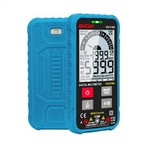
The use of insulation resistance testers and multimeters
insulation resistance tester
Insulation resistance meter, commonly known as megohmmeter, or shaking meter, high resistance meter, insulation resistance tester, etc. Insulation resistance meter is a widely used detection instrument for insulation resistance in power websites and electrical equipment. The insulation properties of electrical products are reflected through insulation resistance.
1. Why do we need insulation resistance testing?
An electrical system is like a piping system, voltage is like liquid pressure, current is like liquid flow rate, and electrical insulation is like pipe walls. Insulation prevents electronic leakage from conductors - the magnitude of its effect is represented by insulation resistance. An effective insulation resistance system has a high resistance value, typically greater than a few megaohms (M Ώ). Poor insulation systems have lower insulation resistance.
In order to detect leaks in the pipeline system, it is necessary to apply pressure. Due to the high water pressure, it is easier to detect leaks, so it is not possible to turn off tap water to check for leaks. However, the available tap water can be restricted so that too much water is not sprayed around when large leaks are detected. An ideal test would be to provide a limited amount of water under high (but not particularly high) pressure. This is exactly what an electrical insulation tester needs to do.
The insulation tester (megohmmeter) applies a direct current voltage to the insulation system and measures the resulting current. This allows for the calculation and display of the insulation resistance value (the degree to which insulation confines current in the wire, or prevents current leakage).
The portable insulation tester (megohmmeter) generally outputs test voltages of 50 V, 100 V, 250 V, 500 V, or 1000 V. Just like in pipeline systems, the purpose is to provide a pressure (voltage) that is not particularly high. I hope to discover existing leaks, but I do not want to cause excessive stress on the system and create new leaks. Lower voltage is used for low-voltage systems, such as telephones, networks, or control lines; Higher pressure is used to test the insulation of power systems.