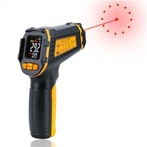
The workings of a light-emitting diode test pen
This paper introduces a novel low-voltage test pen, whose function and usage are exactly the same as those of the traditional neon tube test pen. The ceramic chip emits sound, and displays whether the test point is charged or not in the form of acousto-optic dual indicators, which not only makes the test display more eye-catching, but also overcomes the shortcomings of neon tube leakage and failure, and realizes the solidification of passive test display devices.
As we all know, the test current allowed by the test pencil is generally in the microampere level. It is impossible for such a small current to directly drive the luminous tube to emit light and piezoelectric ceramics to produce sound, but from the perspective of energy, the starting voltage of the neon tube is about 100V, and the starting current is calculated as 1μA, so its minimum luminous power is 0.1mw and The turn-on voltage of the light-emitting diode is 1.6V-2V, the minimum luminous current can be as low as 0.1mA, and its minimum luminous power is about 0.16mW, which is the same order of magnitude as the minimum luminous power of the neon tube. If the energy-collecting circuit is added to increase the pulse power, the light-emitting diode can be driven to emit light with the electric energy of the neon tube. In addition, the current required for piezoelectric ceramics to work is very small, and it is no problem to rely on the test voltage of the neon tube to promote its sound.
Based on the above analysis, the author designed the principle circuit of the electric pen as shown in the attached drawing. The structure of the voltage dividing current limiting resistor R, the test terminal CS, and the touch terminal CM is similar to that of the traditional electric measuring pen. Diodes VD1-VD4 form a rectifier bridge. The piezoelectric ceramic sheet YD is not only used as a sounding element, but also uses its own inherent capacitance to charge and gather energy and pulse discharge. Thyristor VS and trigger tubes VS1~VS4 form an electronic switch, which controls the charging time of YD capacitor, and its trigger voltage can be adjusted by changing the number of trigger tubes, so that the "glow" voltage of the test pen can be adjusted. During the power test, the rectifier bridge turns the weak AC test current into DC, and charges the capacitance of YD itself to gather energy. When the voltage at both ends rises to the trigger voltage of VS1~VS4, VS is triggered by it and conducts quickly. YD discharges and releases energy to the LED through VS in a very short time, and the LED obtains a pulse current whose intensity far exceeds its minimum light-emitting current at an instant, and flashes with a high brightness. At the same time, YD also emits a sound that can be heard by human ears. With the continuous charging and discharging of the YD capacitor, the LED will keep flashing, and the YD will also keep intermittently making sound, so that the electric pen has the function of sound and light dual indication. Of course, you can use a capacitor instead of the YD. At this time, the test pen only has the function of luminous indication, but the brightness will be higher; you can also remove the light-emitting tube to form a single-function audio test pen.
The brightness of the neon tube test pen varies greatly with the use environment, but the flash brightness and sound level of the test pen are only determined by the circuit, and have nothing to do with the use environment, and are basically constant. It's just that the speed of flickering and sounding changes with the size of the test current. The larger the test current, the faster the speed of flickering and sounding, and vice versa. This makes the flashing and sounding speed of the test pen roughly reflect the operator's resistance to ground or the level of the test voltage, because these two factors determine the size of the test current.
When the electric measuring pen is working, the circuit is in a micro-current state, so it has a long service life. After more than a year of experiments and tests by the author, it has been proved that the electrical parameters of the electric pen fully meet the requirements of the electrical safety technical regulations, and the working performance is stable and reliable. As for the design and production of its shell, it can be flexibly controlled under the premise of meeting the technical specifications.
The circuit has been tested by a 1kv megohmmeter, and the equivalent resistance is 3-4MΩ; when the 20MΩ resistor is connected in series and 120V DC voltage is applied to the test, the sound and light flicker frequency is 3-5Hz; compared with the neon tube test pen, under the same voltage, When the glow of the neon tube is very weak, the test pen still operates at 3Hz