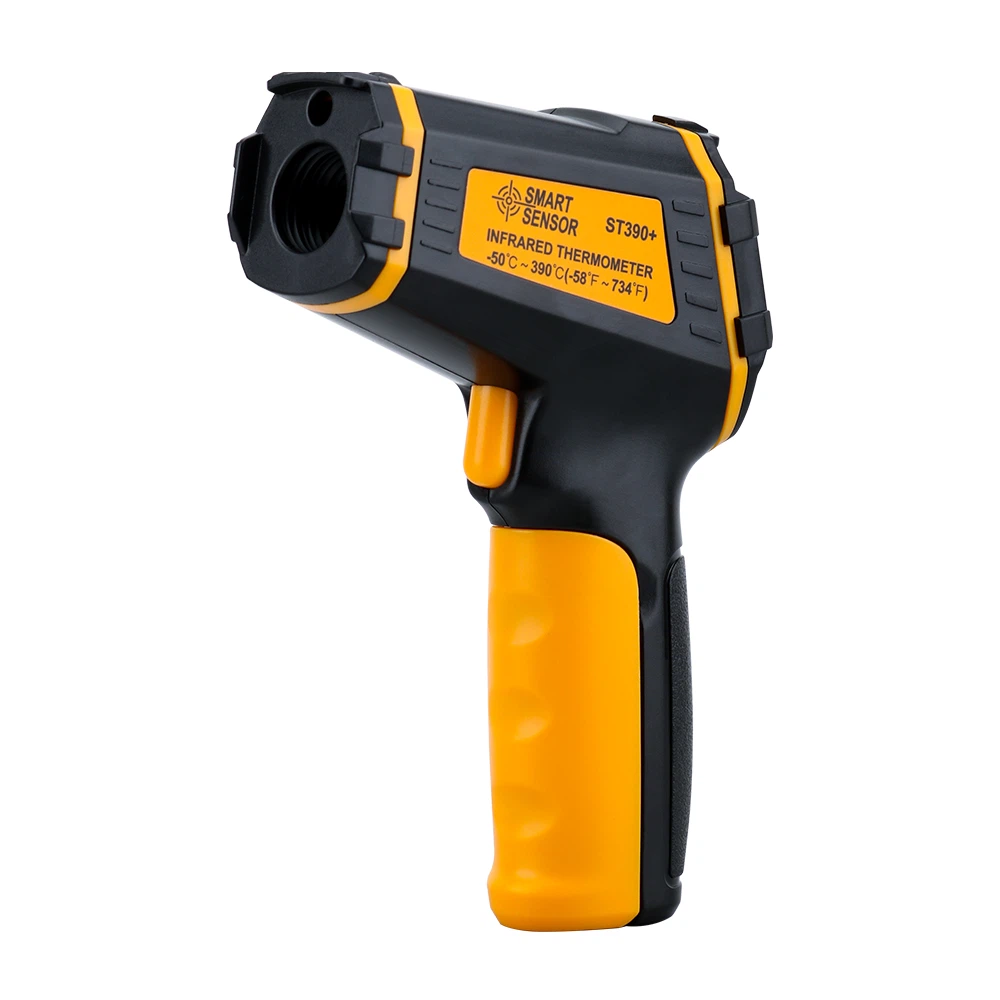
Theoretical principles of infrared temperature measurement
In nature, when the temperature of an object is higher than absolute zero, due to the existence of internal thermal motion, it will continuously radiate electromagnetic waves to the surroundings, including infrared rays with a wavelength range of 0.75μm~100μm. Its biggest feature is that at a given temperature and wavelength, the radiant energy emitted by an object has a maximum value. This material is called a black body, and its reflection coefficient is set to 1. The reflection coefficient of other materials is less than 1, which is called a black body. It is a gray body, because the relationship between the spectral radiation power P (λT) of the black body and the absolute temperature T satisfies Planck's law. It shows that at the absolute temperature T, the radiation power of the black body per unit area at the wavelength λ is P (λT). According to this relationship, the corresponding relationship curve can be obtained, that is:
(1) As the temperature increases, the radiation energy of the object becomes stronger. This is the starting point of infrared radiation theory and the basis for the design of single-band infrared thermometers.
(2) As the temperature increases, the radiation peak moves toward the shortwave direction (to the left), and satisfies Wien's shift theorem. The wavelength at the peak is inversely proportional to the absolute temperature T, and the dotted line is the line connecting the peaks. This formula tells us why high-temperature thermometers mostly work at short waves, and low-temperature thermometers mostly work at long waves.
(3) The rate of change of radiant energy with temperature is greater at short wavelengths than at long waves. That is, thermometers working at short wavelengths have a relatively high signal-to-noise ratio (high sensitivity) and strong anti-interference. The thermometer should try to work at the peak value. This is particularly important at wavelengths, especially in the case of low-temperature small targets.
What is the normal temperature of an infrared thermometer?
The temperature of the infrared thermometer is normal if it is below 36 degrees.
1. When using an infrared thermometer to measure the surface temperature of luminous objects, such as aluminum and stainless steel, the reflection on the surface will affect the reading of the infrared thermometer.
2. Before reading the temperature, you can place a tape on the metal surface. After the temperature is balanced, measure the temperature in the tape area.
3. The infrared thermometer can be used to move back and forth from the kitchen to the refrigerated area and still provide accurate temperature measurement. It must be measured after a period of time in the new environment to achieve temperature equilibrium.
4. It is best to place the thermometer in a frequently used place.